matplotlib.figure
matplotlib.figure implements the following classes:
-
Figure -
Top level
Artist, which holds all plot elements. Many methods are implemented inFigureBase. -
SubFigure -
A logical figure inside a figure, usually added to a figure (or parent
SubFigure) withFigure.add_subfigureorFigure.subfiguresmethods (provisional API v3.4). -
SubplotParams -
Control the default spacing between subplots.
Figures are typically created using pyplot methods figure, subplots, and subplot_mosaic.
fig, ax = plt.subplots(figsize=(2, 2), facecolor='lightskyblue',
                       layout='constrained')
fig.suptitle('Figure')
ax.set_title('Axes', loc='left', fontstyle='oblique', fontsize='medium')
(Source code, png)
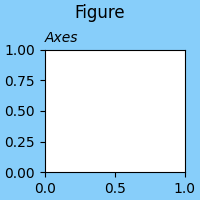

Some situations call for directly instantiating a Figure class, usually inside an application of some sort (see Embedding Matplotlib in graphical user interfaces for a list of examples) . More information about Figures can be found at Creating, viewing, and saving Matplotlib Figures.
- classmatplotlib.figure.Figure(figsize=None, dpi=None, *, facecolor=None, edgecolor=None, linewidth=0.0, frameon=None, subplotpars=None, tight_layout=None, constrained_layout=None, layout=None, **kwargs)[source]
-
The top level container for all the plot elements.
- Attributes:
-
- patch
-
The
Rectangleinstance representing the figure background patch. - suppressComposite
-
For multiple images, the figure will make composite images depending on the renderer option_image_nocomposite function. If suppressComposite is a boolean, this will override the renderer.
- Parameters:
-
- figsize2-tuple of floats, default:
rcParams["figure.figsize"](default:[6.4, 4.8]) -
Figure dimension
(width, height)in inches. - dpifloat, default:
rcParams["figure.dpi"](default:100.0) -
Dots per inch.
- facecolordefault:
rcParams["figure.facecolor"](default:'white') -
The figure patch facecolor.
- edgecolordefault:
rcParams["figure.edgecolor"](default:'white') -
The figure patch edge color.
- linewidthfloat
-
The linewidth of the frame (i.e. the edge linewidth of the figure patch).
- frameonbool, default:
rcParams["figure.frameon"](default:True) -
If
False, suppress drawing the figure background patch. - subplotpars
SubplotParams -
Subplot parameters. If not given, the default subplot parameters
rcParams["figure.subplot.*"]are used. - tight_layoutbool or dict, default:
rcParams["figure.autolayout"](default:False) -
Whether to use the tight layout mechanism. See
set_tight_layout.Discouraged
The use of this parameter is discouraged. Please use
layout='tight'instead for the common case oftight_layout=Trueand useset_tight_layoutotherwise. - constrained_layoutbool, default:
rcParams["figure.constrained_layout.use"](default:False) -
This is equal to
layout='constrained'.Discouraged
The use of this parameter is discouraged. Please use
layout='constrained'instead. - layout{'constrained', 'compressed', 'tight', 'none',
LayoutEngine, None}, default: None -
The layout mechanism for positioning of plot elements to avoid overlapping Axes decorations (labels, ticks, etc). Note that layout managers can have significant performance penalties.
'constrained': The constrained layout solver adjusts axes sizes to avoid overlapping axes decorations. Can handle complex plot layouts and colorbars, and is thus recommended.
See Constrained Layout Guide for examples.
- 'compressed': uses the same algorithm as 'constrained', but removes extra space between fixed-aspect-ratio Axes. Best for simple grids of axes.
- 'tight': Use the tight layout mechanism. This is a relatively simple algorithm that adjusts the subplot parameters so that decorations do not overlap. See
Figure.set_tight_layoutfor further details. - 'none': Do not use a layout engine.
- A
LayoutEngineinstance. Builtin layout classes areConstrainedLayoutEngineandTightLayoutEngine, more easily accessible by 'constrained' and 'tight'. Passing an instance allows third parties to provide their own layout engine.
If not given, fall back to using the parameters tight_layout and constrained_layout, including their config defaults
rcParams["figure.autolayout"](default:False) andrcParams["figure.constrained_layout.use"](default:False).
- figsize2-tuple of floats, default:
- Other Parameters:
-
- **kwargs
Figureproperties, optional -
Property
Description
a filter function, which takes a (m, n, 3) float array and a dpi value, and returns a (m, n, 3) array and two offsets from the bottom left corner of the image
scalar or None
bool
FigureCanvas
bool
Patch or (Path, Transform) or None
unknown
unknown
float
color
color
float
float
bool
str
bool
object
unknown
number
bool
None or bool or float or callable
bool
(float, float) or float
(scale: float, length: float, randomness: float)
bool or None
unknown
str
bool
float
- **kwargs
- add_artist(artist, clip=False)[source]
-
Add an
Artistto the figure.Usually artists are added to
Axesobjects usingAxes.add_artist; this method can be used in the rare cases where one needs to add artists directly to the figure instead.
- add_axes(*args, **kwargs)[source]
-
Add an
Axesto the figure.Call signatures:
add_axes(rect, projection=None, polar=False, **kwargs) add_axes(ax)- Parameters:
-
- recttuple (left, bottom, width, height)
-
The dimensions (left, bottom, width, height) of the new
Axes. All quantities are in fractions of figure width and height. - projection{None, 'aitoff', 'hammer', 'lambert', 'mollweide', 'polar', 'rectilinear', str}, optional
-
The projection type of the
Axes. str is the name of a custom projection, seeprojections. The default None results in a 'rectilinear' projection. - polarbool, default: False
-
If True, equivalent to projection='polar'.
- axes_classsubclass type of
Axes, optional -
The
axes.Axessubclass that is instantiated. This parameter is incompatible with projection and polar. See axisartist for examples. - sharex, sharey
Axes, optional -
Share the x or y
axiswith sharex and/or sharey. The axis will have the same limits, ticks, and scale as the axis of the shared axes. - labelstr
-
A label for the returned Axes.
- Returns:
-
Axes, or a subclass ofAxes-
The returned axes class depends on the projection used. It is
Axesif rectilinear projection is used andprojections.polar.PolarAxesif polar projection is used.
- Other Parameters:
-
- **kwargs
-
This method also takes the keyword arguments for the returned Axes class. The keyword arguments for the rectilinear Axes class
Axescan be found in the following table but there might also be other keyword arguments if another projection is used, see the actual Axes class.Property
Description
{'box', 'datalim'}
a filter function, which takes a (m, n, 3) float array and a dpi value, and returns a (m, n, 3) array and two offsets from the bottom left corner of the image
scalar or None
(float, float) or {'C', 'SW', 'S', 'SE', 'E', 'NE', ...}
bool
{'auto', 'equal'} or float
bool
unknown
unknown
Callable[[Axes, Renderer], Bbox]
bool or 'line'
float or None
bool
Patch or (Path, Transform) or None
facecoloror fccolor
bool
str
bool
object
bool
bool
unknown
None or bool or float or callable
[left, bottom, width, height] or
Bboxunknown
float or None
bool
(scale: float, length: float, randomness: float)
bool or None
unknown
str
str
bool
unknown
str
(bottom: float, top: float)
float greater than -0.5
unknown
unknown
unknown
unknown
str
(bottom: float, top: float)
float greater than -0.5
unknown
unknown
unknown
float
Notes
In rare circumstances,
add_axesmay be called with a single argument, an Axes instance already created in the present figure but not in the figure's list of Axes.Examples
Some simple examples:
rect = l, b, w, h
fig = plt.figure()
fig.add_axes(rect)
fig.add_axes(rect, frameon=False, facecolor='g')
fig.add_axes(rect, polar=True)
ax = fig.add_axes(rect, projection='polar')
fig.delaxes(ax)
fig.add_axes(ax)
- add_axobserver(func)[source]
-
Whenever the Axes state change,
func(self)will be called.
- add_callback(func)[source]
-
Add a callback function that will be called whenever one of the
Artist's properties changes.- Parameters:
-
- funccallable
-
The callback function. It must have the signature:
def func(artist: Artist) -> Anywhere artist is the calling
Artist. Return values may exist but are ignored.
- Returns:
-
- int
-
The observer id associated with the callback. This id can be used for removing the callback with
remove_callbacklater.
See also
- add_gridspec(nrows=1, ncols=1, **kwargs)[source]
-
Return a
GridSpecthat has this figure as a parent. This allows complex layout of Axes in the figure.- Parameters:
-
- nrowsint, default: 1
-
Number of rows in grid.
- ncolsint, default: 1
-
Number of columns in grid.
- Returns:
- Other Parameters:
-
- **kwargs
-
Keyword arguments are passed to
GridSpec.
See also
Examples
Adding a subplot that spans two rows:
fig = plt.figure()
gs = fig.add_gridspec(2, 2)
ax1 = fig.add_subplot(gs[0, 0])
ax2 = fig.add_subplot(gs[1, 0])
# spans two rows:
ax3 = fig.add_subplot(gs[:, 1])
- add_subfigure(subplotspec, **kwargs)[source]
-
Add a
SubFigureto the figure as part of a subplot arrangement.- Parameters:
-
- subplotspec
gridspec.SubplotSpec -
Defines the region in a parent gridspec where the subfigure will be placed.
- subplotspec
- Returns:
- Other Parameters:
-
- **kwargs
-
Are passed to the
SubFigureobject.
See also
- add_subplot(*args, **kwargs)[source]
-
Add an
Axesto the figure as part of a subplot arrangement.Call signatures:
add_subplot(nrows, ncols, index, **kwargs) add_subplot(pos, **kwargs) add_subplot(ax) add_subplot()- Parameters:
-
- *argsint, (int, int, index), or
SubplotSpec, default: (1, 1, 1) -
The position of the subplot described by one of
- Three integers (nrows, ncols, index). The subplot will take the index position on a grid with nrows rows and ncols columns. index starts at 1 in the upper left corner and increases to the right. index can also be a two-tuple specifying the (first, last) indices (1-based, and including last) of the subplot, e.g.,
fig.add_subplot(3, 1, (1, 2))makes a subplot that spans the upper 2/3 of the figure. - A 3-digit integer. The digits are interpreted as if given separately as three single-digit integers, i.e.
fig.add_subplot(235)is the same asfig.add_subplot(2, 3, 5). Note that this can only be used if there are no more than 9 subplots. - A
SubplotSpec.
In rare circumstances,
add_subplotmay be called with a single argument, a subplot Axes instance already created in the present figure but not in the figure's list of Axes. - Three integers (nrows, ncols, index). The subplot will take the index position on a grid with nrows rows and ncols columns. index starts at 1 in the upper left corner and increases to the right. index can also be a two-tuple specifying the (first, last) indices (1-based, and including last) of the subplot, e.g.,
- projection{None, 'aitoff', 'hammer', 'lambert', 'mollweide', 'polar', 'rectilinear', str}, optional
-
The projection type of the subplot (
Axes). str is the name of a custom projection, seeprojections. The default None results in a 'rectilinear' projection. - polarbool, default: False
-
If True, equivalent to projection='polar'.
- axes_classsubclass type of
Axes, optional -
The
axes.Axessubclass that is instantiated. This parameter is incompatible with projection and polar. See axisartist for examples. - sharex, sharey
Axes, optional -
Share the x or y
axiswith sharex and/or sharey. The axis will have the same limits, ticks, and scale as the axis of the shared axes. - labelstr
-
A label for the returned Axes.
- *argsint, (int, int, index), or
- Returns:
-
-
Axes -
The Axes of the subplot. The returned Axes can actually be an instance of a subclass, such as
projections.polar.PolarAxesfor polar projections.
-
- Other Parameters:
-
- **kwargs
-
This method also takes the keyword arguments for the returned Axes base class; except for the figure argument. The keyword arguments for the rectilinear base class
Axescan be found in the following table but there might also be other keyword arguments if another projection is used.Property
Description
{'box', 'datalim'}
a filter function, which takes a (m, n, 3) float array and a dpi value, and returns a (m, n, 3) array and two offsets from the bottom left corner of the image
scalar or None
(float, float) or {'C', 'SW', 'S', 'SE', 'E', 'NE', ...}
bool
{'auto', 'equal'} or float
bool
unknown
unknown
Callable[[Axes, Renderer], Bbox]
bool or 'line'
float or None
bool
Patch or (Path, Transform) or None
facecoloror fccolor
bool
str
bool
object
bool
bool
unknown
None or bool or float or callable
[left, bottom, width, height] or
Bboxunknown
float or None
bool
(scale: float, length: float, randomness: float)
bool or None
unknown
str
str
bool
unknown
str
(bottom: float, top: float)
float greater than -0.5
unknown
unknown
unknown
unknown
str
(bottom: float, top: float)
float greater than -0.5
unknown
unknown
unknown
float
Examples
fig = plt.figure()

fig.add_subplot(231)
ax1 = fig.add_subplot(2, 3, 1)  # equivalent but more general

fig.add_subplot(232, frameon=False)  # subplot with no frame
fig.add_subplot(233, projection='polar')  # polar subplot
fig.add_subplot(234, sharex=ax1)  # subplot sharing x-axis with ax1
fig.add_subplot(235, facecolor="red")  # red subplot

ax1.remove()  # delete ax1 from the figure
fig.add_subplot(ax1)  # add ax1 back to the figure
- align_labels(axs=None)[source]
-
Align the xlabels and ylabels of subplots with the same subplots row or column (respectively) if label alignment is being done automatically (i.e. the label position is not manually set).
Alignment persists for draw events after this is called.
- align_xlabels(axs=None)[source]
-
Align the xlabels of subplots in the same subplot column if label alignment is being done automatically (i.e. the label position is not manually set).
Alignment persists for draw events after this is called.
If a label is on the bottom, it is aligned with labels on Axes that also have their label on the bottom and that have the same bottom-most subplot row. If the label is on the top, it is aligned with labels on Axes with the same top-most row.
- Parameters:
Notes
This assumes that
axsare from the sameGridSpec, so that theirSubplotSpecpositions correspond to figure positions.Examples
Example with rotated xtick labels:
fig, axs = plt.subplots(1, 2)
for tick in axs[0].get_xticklabels():
    tick.set_rotation(55)
axs[0].set_xlabel('XLabel 0')
axs[1].set_xlabel('XLabel 1')
fig.align_xlabels()
- align_ylabels(axs=None)[source]
-
Align the ylabels of subplots in the same subplot column if label alignment is being done automatically (i.e. the label position is not manually set).
Alignment persists for draw events after this is called.
If a label is on the left, it is aligned with labels on Axes that also have their label on the left and that have the same left-most subplot column. If the label is on the right, it is aligned with labels on Axes with the same right-most column.
- Parameters:
Notes
This assumes that
axsare from the sameGridSpec, so that theirSubplotSpecpositions correspond to figure positions.Examples
Example with large yticks labels:
fig, axs = plt.subplots(2, 1)
axs[0].plot(np.arange(0, 1000, 50))
axs[0].set_ylabel('YLabel 0')
axs[1].set_ylabel('YLabel 1')
fig.align_ylabels()
- autofmt_xdate(bottom=0.2, rotation=30, ha='right', which='major')[source]
-
Date ticklabels often overlap, so it is useful to rotate them and right align them. Also, a common use case is a number of subplots with shared x-axis where the x-axis is date data. The ticklabels are often long, and it helps to rotate them on the bottom subplot and turn them off on other subplots, as well as turn off xlabels.
- Parameters:
-
- bottomfloat, default: 0.2
-
The bottom of the subplots for
subplots_adjust. - rotationfloat, default: 30 degrees
-
The rotation angle of the xtick labels in degrees.
- ha{'left', 'center', 'right'}, default: 'right'
-
The horizontal alignment of the xticklabels.
- which{'major', 'minor', 'both'}, default: 'major'
-
Selects which ticklabels to rotate.
- propertyaxes
-
List of Axes in the Figure. You can access and modify the Axes in the Figure through this list.
Do not modify the list itself. Instead, use
add_axes,add_subplotordelaxesto add or remove an Axes.Note: The
Figure.axesproperty andget_axesmethod are equivalent.
- propertycallbacks[source]
- clear(keep_observers=False)[source]
-
Clear the figure.
- Parameters:
-
- keep_observersbool, default: False
-
Set keep_observers to True if, for example, a gui widget is tracking the Axes in the figure.
- clf(keep_observers=False)[source]
-
[Discouraged] Alias for the
clear()method.Discouraged
The use of
clf()is discouraged. Useclear()instead.- Parameters:
-
- keep_observersbool, default: False
-
Set keep_observers to True if, for example, a gui widget is tracking the Axes in the figure.
- colorbar(mappable, cax=None, ax=None, use_gridspec=True, **kwargs)[source]
-
Add a colorbar to a plot.
- Parameters:
-
- mappable
-
The
matplotlib.cm.ScalarMappable(i.e.,AxesImage,ContourSet, etc.) described by this colorbar. This argument is mandatory for theFigure.colorbarmethod but optional for thepyplot.colorbarfunction, which sets the default to the current image.Note that one can create a
ScalarMappable"on-the-fly" to generate colorbars not attached to a previously drawn artist, e.g.fig.colorbar(cm.ScalarMappable(norm=norm, cmap=cmap), ax=ax) - cax
Axes, optional -
Axes into which the colorbar will be drawn.
- ax
Axesor iterable ornumpy.ndarrayof Axes, optional -
One or more parent axes from which space for a new colorbar axes will be stolen, if cax is None. This has no effect if cax is set.
- use_gridspecbool, optional
-
If cax is
None, a new cax is created as an instance of Axes. If ax is positioned with a subplotspec and use_gridspec isTrue, then cax is also positioned with a subplotspec.
- Returns:
-
- colorbar
Colorbar
- colorbar
- Other Parameters:
-
- locationNone or {'left', 'right', 'top', 'bottom'}
-
The location, relative to the parent axes, where the colorbar axes is created. It also determines the orientation of the colorbar (colorbars on the left and right are vertical, colorbars at the top and bottom are horizontal). If None, the location will come from the orientation if it is set (vertical colorbars on the right, horizontal ones at the bottom), or default to 'right' if orientation is unset.
- orientationNone or {'vertical', 'horizontal'}
-
The orientation of the colorbar. It is preferable to set the location of the colorbar, as that also determines the orientation; passing incompatible values for location and orientation raises an exception.
- fractionfloat, default: 0.15
-
Fraction of original axes to use for colorbar.
- shrinkfloat, default: 1.0
-
Fraction by which to multiply the size of the colorbar.
- aspectfloat, default: 20
-
Ratio of long to short dimensions.
- padfloat, default: 0.05 if vertical, 0.15 if horizontal
-
Fraction of original axes between colorbar and new image axes.
- anchor(float, float), optional
-
The anchor point of the colorbar axes. Defaults to (0.0, 0.5) if vertical; (0.5, 1.0) if horizontal.
- panchor(float, float), or False, optional
-
The anchor point of the colorbar parent axes. If False, the parent axes' anchor will be unchanged. Defaults to (1.0, 0.5) if vertical; (0.5, 0.0) if horizontal.
- extend{'neither', 'both', 'min', 'max'}
-
Make pointed end(s) for out-of-range values (unless 'neither'). These are set for a given colormap using the colormap set_under and set_over methods.
- extendfrac{None, 'auto', length, lengths}
-
If set to None, both the minimum and maximum triangular colorbar extensions will have a length of 5% of the interior colorbar length (this is the default setting).
If set to 'auto', makes the triangular colorbar extensions the same lengths as the interior boxes (when spacing is set to 'uniform') or the same lengths as the respective adjacent interior boxes (when spacing is set to 'proportional').
If a scalar, indicates the length of both the minimum and maximum triangular colorbar extensions as a fraction of the interior colorbar length. A two-element sequence of fractions may also be given, indicating the lengths of the minimum and maximum colorbar extensions respectively as a fraction of the interior colorbar length.
- extendrectbool
-
If False the minimum and maximum colorbar extensions will be triangular (the default). If True the extensions will be rectangular.
- spacing{'uniform', 'proportional'}
-
For discrete colorbars (
BoundaryNormor contours), 'uniform' gives each color the same space; 'proportional' makes the space proportional to the data interval. - ticksNone or list of ticks or Locator
-
If None, ticks are determined automatically from the input.
- formatNone or str or Formatter
-
If None,
ScalarFormatteris used. Format strings, e.g.,"%4.2e"or"{x:.2e}", are supported. An alternativeFormattermay be given instead. - drawedgesbool
-
Whether to draw lines at color boundaries.
- labelstr
-
The label on the colorbar's long axis.
- boundaries, valuesNone or a sequence
-
If unset, the colormap will be displayed on a 0-1 scale. If sequences, values must have a length 1 less than boundaries. For each region delimited by adjacent entries in boundaries, the color mapped to the corresponding value in values will be used. Normally only useful for indexed colors (i.e.
norm=NoNorm()) or other unusual circumstances.
Notes
If mappable is a
ContourSet, its extend kwarg is included automatically.The shrink kwarg provides a simple way to scale the colorbar with respect to the axes. Note that if cax is specified, it determines the size of the colorbar and shrink and aspect kwargs are ignored.
For more precise control, you can manually specify the positions of the axes objects in which the mappable and the colorbar are drawn. In this case, do not use any of the axes properties kwargs.
It is known that some vector graphics viewers (svg and pdf) renders white gaps between segments of the colorbar. This is due to bugs in the viewers, not Matplotlib. As a workaround, the colorbar can be rendered with overlapping segments:
cbar = colorbar()
cbar.solids.set_edgecolor("face")
draw()
However, this has negative consequences in other circumstances, e.g. with semi-transparent images (alpha < 1) and colorbar extensions; therefore, this workaround is not used by default (see issue #1188).
- contains(mouseevent)[source]
-
Test whether the mouse event occurred on the figure.
- Returns:
-
- bool, {}
- convert_xunits(x)[source]
-
Convert x using the unit type of the xaxis.
If the artist is not contained in an Axes or if the xaxis does not have units, x itself is returned.
- convert_yunits(y)[source]
-
Convert y using the unit type of the yaxis.
If the artist is not contained in an Axes or if the yaxis does not have units, y itself is returned.
- propertydpi
-
The resolution in dots per inch.
- draw(renderer)[source]
-
Draw the Artist (and its children) using the given renderer.
This has no effect if the artist is not visible (
Artist.get_visiblereturns False).- Parameters:
-
- renderer
RendererBasesubclass.
- renderer
Notes
This method is overridden in the Artist subclasses.
- draw_without_rendering()[source]
-
Draw the figure with no output. Useful to get the final size of artists that require a draw before their size is known (e.g. text).
- execute_constrained_layout(renderer=None)[source]
-
[Deprecated] Use
layoutgridto determine pos positions within Axes.See also
set_constrained_layout_pads.- Returns:
-
- layoutgridprivate debugging object
Notes
Deprecated since version 3.6: Use figure.get_layout_engine().execute() instead.
- figimage(X, xo=0, yo=0, alpha=None, norm=None, cmap=None, vmin=None, vmax=None, origin=None, resize=False, **kwargs)[source]
-
Add a non-resampled image to the figure.
The image is attached to the lower or upper left corner depending on origin.
- Parameters:
-
- X
-
The image data. This is an array of one of the following shapes:
- (M, N): an image with scalar data. Color-mapping is controlled by cmap, norm, vmin, and vmax.
- (M, N, 3): an image with RGB values (0-1 float or 0-255 int).
- (M, N, 4): an image with RGBA values (0-1 float or 0-255 int), i.e. including transparency.
- xo, yoint
-
The x/y image offset in pixels.
- alphaNone or float
-
The alpha blending value.
- cmapstr or
Colormap, default:rcParams["image.cmap"](default:'viridis') -
The Colormap instance or registered colormap name used to map scalar data to colors.
This parameter is ignored if X is RGB(A).
- normstr or
Normalize, optional -
The normalization method used to scale scalar data to the [0, 1] range before mapping to colors using cmap. By default, a linear scaling is used, mapping the lowest value to 0 and the highest to 1.
If given, this can be one of the following:
- An instance of
Normalizeor one of its subclasses (see Colormap Normalization). - A scale name, i.e. one of "linear", "log", "symlog", "logit", etc. For a list of available scales, call
matplotlib.scale.get_scale_names(). In that case, a suitableNormalizesubclass is dynamically generated and instantiated.
This parameter is ignored if X is RGB(A).
- An instance of
- vmin, vmaxfloat, optional
-
When using scalar data and no explicit norm, vmin and vmax define the data range that the colormap covers. By default, the colormap covers the complete value range of the supplied data. It is an error to use vmin/vmax when a norm instance is given (but using a
strnorm name together with vmin/vmax is acceptable).This parameter is ignored if X is RGB(A).
- origin{'upper', 'lower'}, default:
rcParams["image.origin"](default:'upper') -
Indicates where the [0, 0] index of the array is in the upper left or lower left corner of the axes.
- resizebool
-
If True, resize the figure to match the given image size.
- Returns:
- Other Parameters:
-
- **kwargs
-
Additional kwargs are
Artistkwargs passed on toFigureImage.
Notes
figimage complements the Axes image (
imshow) which will be resampled to fit the current Axes. If you want a resampled image to fill the entire figure, you can define anAxeswith extent [0, 0, 1, 1].Examples
f = plt.figure()
nx = int(f.get_figwidth() * f.dpi)
ny = int(f.get_figheight() * f.dpi)
data = np.random.random((ny, nx))
f.figimage(data)
plt.show()
- findobj(match=None, include_self=True)[source]
-
Find artist objects.
Recursively find all
Artistinstances contained in the artist.- Parameters:
-
- match
-
A filter criterion for the matches. This can be
- None: Return all objects contained in artist.
- A function with signature
def match(artist: Artist) -> bool. The result will only contain artists for which the function returns True. - A class instance: e.g.,
Line2D. The result will only contain artists of this class or its subclasses (isinstancecheck).
- include_selfbool
-
Include self in the list to be checked for a match.
- Returns:
-
-
list of
Artist
-
list of
- format_cursor_data(data)[source]
-
Return a string representation of data.
Note
This method is intended to be overridden by artist subclasses. As an end-user of Matplotlib you will most likely not call this method yourself.
The default implementation converts ints and floats and arrays of ints and floats into a comma-separated string enclosed in square brackets, unless the artist has an associated colorbar, in which case scalar values are formatted using the colorbar's formatter.
See also
- propertyframeon
-
Return the figure's background patch visibility, i.e. whether the figure background will be drawn. Equivalent to
Figure.patch.get_visible().
- gca()[source]
-
Get the current Axes.
If there is currently no Axes on this Figure, a new one is created using
Figure.add_subplot. (To test whether there is currently an Axes on a Figure, check whetherfigure.axesis empty. To test whether there is currently a Figure on the pyplot figure stack, check whetherpyplot.get_fignums()is empty.)
- get_agg_filter()[source]
-
Return filter function to be used for agg filter.
- get_alpha()[source]
-
Return the alpha value used for blending - not supported on all backends.
- get_animated()[source]
-
Return whether the artist is animated.
- get_axes()[source]
-
List of Axes in the Figure. You can access and modify the Axes in the Figure through this list.
Do not modify the list itself. Instead, use
add_axes,add_subplotordelaxesto add or remove an Axes.Note: The
Figure.axesproperty andget_axesmethod are equivalent.
- get_children()[source]
-
Get a list of artists contained in the figure.
- get_clip_box()[source]
-
Return the clipbox.
- get_clip_on()[source]
-
Return whether the artist uses clipping.
- get_clip_path()[source]
-
Return the clip path.
- get_constrained_layout()[source]
-
Return whether constrained layout is being used.
- get_constrained_layout_pads(relative=False)[source]
-
[Deprecated] Get padding for
constrained_layout.Returns a list of
w_pad, h_padin inches andwspaceandhspaceas fractions of the subplot. All values are None ifconstrained_layoutis not used.- Parameters:
-
- relativebool
-
If
True, then convert from inches to figure relative.
Notes
Deprecated since version 3.6: Use fig.get_layout_engine().get() instead.
- get_cursor_data(event)[source]
-
Return the cursor data for a given event.
Note
This method is intended to be overridden by artist subclasses. As an end-user of Matplotlib you will most likely not call this method yourself.
Cursor data can be used by Artists to provide additional context information for a given event. The default implementation just returns None.
Subclasses can override the method and return arbitrary data. However, when doing so, they must ensure that
format_cursor_datacan convert the data to a string representation.The only current use case is displaying the z-value of an
AxesImagein the status bar of a plot window, while moving the mouse.- Parameters:
See also
- get_default_bbox_extra_artists()[source]
- get_dpi()[source]
-
Return the resolution in dots per inch as a float.
- get_edgecolor()[source]
-
Get the edge color of the Figure rectangle.
- get_facecolor()[source]
-
Get the face color of the Figure rectangle.
- get_figheight()[source]
-
Return the figure height in inches.
- get_figwidth()[source]
-
Return the figure width in inches.
- get_frameon()[source]
-
Return the figure's background patch visibility, i.e. whether the figure background will be drawn. Equivalent to
Figure.patch.get_visible().
- get_gid()[source]
-
Return the group id.
- get_in_layout()[source]
-
Return boolean flag,
Trueif artist is included in layout calculations.E.g. Constrained Layout Guide,
Figure.tight_layout(), andfig.savefig(fname, bbox_inches='tight').
- get_label()[source]
-
Return the label used for this artist in the legend.
- get_layout_engine()[source]
- get_linewidth()[source]
-
Get the line width of the Figure rectangle.
- get_mouseover()[source]
-
Return whether this artist is queried for custom context information when the mouse cursor moves over it.
- get_path_effects()[source]
- get_picker()[source]
-
Return the picking behavior of the artist.
The possible values are described in
set_picker.See also
- get_rasterized()[source]
-
Return whether the artist is to be rasterized.
- get_size_inches()[source]
-
Return the current size of the figure in inches.
- Returns:
-
- ndarray
-
The size (width, height) of the figure in inches.
See also
Notes
The size in pixels can be obtained by multiplying with
Figure.dpi.
- get_sketch_params()[source]
-
Return the sketch parameters for the artist.
- Returns:
-
- tuple or None
-
A 3-tuple with the following elements:
- scale: The amplitude of the wiggle perpendicular to the source line.
- length: The length of the wiggle along the line.
- randomness: The scale factor by which the length is shrunken or expanded.
Returns None if no sketch parameters were set.
- get_tight_layout()[source]
-
Return whether
tight_layoutis called when drawing.
- get_tightbbox(renderer=None, bbox_extra_artists=None)[source]
-
Return a (tight) bounding box of the figure in inches.
Note that
FigureBasediffers from all other artists, which return theirBboxin pixels.Artists that have
artist.set_in_layout(False)are not included in the bbox.- Parameters:
-
- renderer
RendererBasesubclass -
Renderer that will be used to draw the figures (i.e.
fig.canvas.get_renderer()) - bbox_extra_artistslist of
ArtistorNone -
List of artists to include in the tight bounding box. If
None(default), then all artist children of each Axes are included in the tight bounding box.
- renderer
- Returns:
-
-
BboxBase -
containing the bounding box (in figure inches).
-
- get_transformed_clip_path_and_affine()[source]
-
Return the clip path with the non-affine part of its transformation applied, and the remaining affine part of its transformation.
- get_url()[source]
-
Return the url.
- get_visible()[source]
-
Return the visibility.
- get_window_extent(renderer=None, *args, **kwargs)[source]
-
Get the artist's bounding box in display space.
The bounding box' width and height are nonnegative.
Subclasses should override for inclusion in the bounding box "tight" calculation. Default is to return an empty bounding box at 0, 0.
Be careful when using this function, the results will not update if the artist window extent of the artist changes. The extent can change due to any changes in the transform stack, such as changing the axes limits, the figure size, or the canvas used (as is done when saving a figure). This can lead to unexpected behavior where interactive figures will look fine on the screen, but will save incorrectly.
- get_zorder()[source]
-
Return the artist's zorder.
- ginput(n=1, timeout=30, show_clicks=True, mouse_add=MouseButton.LEFT, mouse_pop=MouseButton.RIGHT, mouse_stop=MouseButton.MIDDLE)[source]
-
Blocking call to interact with a figure.
Wait until the user clicks n times on the figure, and return the coordinates of each click in a list.
There are three possible interactions:
- Add a point.
- Remove the most recently added point.
- Stop the interaction and return the points added so far.
The actions are assigned to mouse buttons via the arguments mouse_add, mouse_pop and mouse_stop.
- Parameters:
-
- nint, default: 1
-
Number of mouse clicks to accumulate. If negative, accumulate clicks until the input is terminated manually.
- timeoutfloat, default: 30 seconds
-
Number of seconds to wait before timing out. If zero or negative will never time out.
- show_clicksbool, default: True
-
If True, show a red cross at the location of each click.
- mouse_add
MouseButtonor None, default:MouseButton.LEFT -
Mouse button used to add points.
- mouse_pop
MouseButtonor None, default:MouseButton.RIGHT -
Mouse button used to remove the most recently added point.
- mouse_stop
MouseButtonor None, default:MouseButton.MIDDLE -
Mouse button used to stop input.
- Returns:
-
- list of tuples
-
A list of the clicked (x, y) coordinates.
Notes
The keyboard can also be used to select points in case your mouse does not have one or more of the buttons. The delete and backspace keys act like right-clicking (i.e., remove last point), the enter key terminates input and any other key (not already used by the window manager) selects a point.
- have_units()[source]
-
Return whether units are set on any axis.
- is_transform_set()[source]
-
Return whether the Artist has an explicitly set transform.
This is True after
set_transformhas been called.
- legend(*args, **kwargs)[source]
-
Place a legend on the figure.
Call signatures:
legend()
legend(handles, labels)
legend(handles=handles)
legend(labels)
The call signatures correspond to the following different ways to use this method:
1. Automatic detection of elements to be shown in the legend
The elements to be added to the legend are automatically determined, when you do not pass in any extra arguments.
In this case, the labels are taken from the artist. You can specify them either at artist creation or by calling the
set_label()method on the artist:ax.plot([1, 2, 3], label='Inline label') fig.legend()or:
line, = ax.plot([1, 2, 3])
line.set_label('Label via method')
fig.legend()
Specific lines can be excluded from the automatic legend element selection by defining a label starting with an underscore. This is default for all artists, so calling
Figure.legendwithout any arguments and without setting the labels manually will result in no legend being drawn.2. Explicitly listing the artists and labels in the legend
For full control of which artists have a legend entry, it is possible to pass an iterable of legend artists followed by an iterable of legend labels respectively:
fig.legend([line1, line2, line3], ['label1', 'label2', 'label3'])3. Explicitly listing the artists in the legend
This is similar to 2, but the labels are taken from the artists' label properties. Example:
line1, = ax1.plot([1, 2, 3], label='label1')
line2, = ax2.plot([1, 2, 3], label='label2')
fig.legend(handles=[line1, line2])
4. Labeling existing plot elements
Discouraged
This call signature is discouraged, because the relation between plot elements and labels is only implicit by their order and can easily be mixed up.
To make a legend for all artists on all Axes, call this function with an iterable of strings, one for each legend item. For example:
fig, (ax1, ax2) = plt.subplots(1, 2) ax1.plot([1, 3, 5], color='blue') ax2.plot([2, 4, 6], color='red') fig.legend(['the blues', 'the reds'])- Parameters:
-
- handleslist of
Artist, optional -
A list of Artists (lines, patches) to be added to the legend. Use this together with labels, if you need full control on what is shown in the legend and the automatic mechanism described above is not sufficient.
The length of handles and labels should be the same in this case. If they are not, they are truncated to the smaller length.
- labelslist of str, optional
-
A list of labels to show next to the artists. Use this together with handles, if you need full control on what is shown in the legend and the automatic mechanism described above is not sufficient.
- handleslist of
- Returns:
- Other Parameters:
-
- locstr or pair of floats, default: 'upper right'
-
The location of the legend.
The strings
'upper left','upper right','lower left','lower right'place the legend at the corresponding corner of the figure.The strings
'upper center','lower center','center left','center right'place the legend at the center of the corresponding edge of the figure.The string
'center'places the legend at the center of the figure.The location can also be a 2-tuple giving the coordinates of the lower-left corner of the legend in figure coordinates (in which case bbox_to_anchor will be ignored).
For back-compatibility,
'center right'(but no other location) can also be spelled'right', and each "string" location can also be given as a numeric value:Location String
Location Code
'best' (Axes only)
0
'upper right'
1
'upper left'
2
'lower left'
3
'lower right'
4
'right'
5
'center left'
6
'center right'
7
'lower center'
8
'upper center'
9
'center'
10
If a figure is using the constrained layout manager, the string codes of the loc keyword argument can get better layout behaviour using the prefix 'outside'. There is ambiguity at the corners, so 'outside upper right' will make space for the legend above the rest of the axes in the layout, and 'outside right upper' will make space on the right side of the layout. In addition to the values of loc listed above, we have 'outside right upper', 'outside right lower', 'outside left upper', and 'outside left lower'. See Legend guide for more details.
- bbox_to_anchor
BboxBase, 2-tuple, or 4-tuple of floats -
Box that is used to position the legend in conjunction with loc. Defaults to
axes.bbox(if called as a method toAxes.legend) orfigure.bbox(ifFigure.legend). This argument allows arbitrary placement of the legend.Bbox coordinates are interpreted in the coordinate system given by bbox_transform, with the default transform Axes or Figure coordinates, depending on which
legendis called.If a 4-tuple or
BboxBaseis given, then it specifies the bbox(x, y, width, height)that the legend is placed in. To put the legend in the best location in the bottom right quadrant of the axes (or figure):loc='best', bbox_to_anchor=(0.5, 0., 0.5, 0.5)A 2-tuple
(x, y)places the corner of the legend specified by loc at x, y. For example, to put the legend's upper right-hand corner in the center of the axes (or figure) the following keywords can be used:loc='upper right', bbox_to_anchor=(0.5, 0.5) - ncolsint, default: 1
-
The number of columns that the legend has.
For backward compatibility, the spelling ncol is also supported but it is discouraged. If both are given, ncols takes precedence.
- propNone or
matplotlib.font_manager.FontPropertiesor dict -
The font properties of the legend. If None (default), the current
matplotlib.rcParamswill be used. - fontsizeint or {'xx-small', 'x-small', 'small', 'medium', 'large', 'x-large', 'xx-large'}
-
The font size of the legend. If the value is numeric the size will be the absolute font size in points. String values are relative to the current default font size. This argument is only used if prop is not specified.
- labelcolorstr or list, default:
rcParams["legend.labelcolor"](default:'None') -
The color of the text in the legend. Either a valid color string (for example, 'red'), or a list of color strings. The labelcolor can also be made to match the color of the line or marker using 'linecolor', 'markerfacecolor' (or 'mfc'), or 'markeredgecolor' (or 'mec').
Labelcolor can be set globally using
rcParams["legend.labelcolor"](default:'None'). If None, usercParams["text.color"](default:'black'). - numpointsint, default:
rcParams["legend.numpoints"](default:1) -
The number of marker points in the legend when creating a legend entry for a
Line2D(line). - scatterpointsint, default:
rcParams["legend.scatterpoints"](default:1) -
The number of marker points in the legend when creating a legend entry for a
PathCollection(scatter plot). - scatteryoffsetsiterable of floats, default:
[0.375, 0.5, 0.3125] -
The vertical offset (relative to the font size) for the markers created for a scatter plot legend entry. 0.0 is at the base the legend text, and 1.0 is at the top. To draw all markers at the same height, set to
[0.5]. - markerscalefloat, default:
rcParams["legend.markerscale"](default:1.0) -
The relative size of legend markers compared to the originally drawn ones.
- markerfirstbool, default: True
-
If True, legend marker is placed to the left of the legend label. If False, legend marker is placed to the right of the legend label.
- reversebool, default: False
-
If True, the legend labels are displayed in reverse order from the input. If False, the legend labels are displayed in the same order as the input.
New in version 3.7.
- frameonbool, default:
rcParams["legend.frameon"](default:True) -
Whether the legend should be drawn on a patch (frame).
- fancyboxbool, default:
rcParams["legend.fancybox"](default:True) -
Whether round edges should be enabled around the
FancyBboxPatchwhich makes up the legend's background. - shadowbool, default:
rcParams["legend.shadow"](default:False) -
Whether to draw a shadow behind the legend.
- framealphafloat, default:
rcParams["legend.framealpha"](default:0.8) -
The alpha transparency of the legend's background. If shadow is activated and framealpha is
None, the default value is ignored. - facecolor"inherit" or color, default:
rcParams["legend.facecolor"](default:'inherit') -
The legend's background color. If
"inherit", usercParams["axes.facecolor"](default:'white'). - edgecolor"inherit" or color, default:
rcParams["legend.edgecolor"](default:'0.8') -
The legend's background patch edge color. If
"inherit", use takercParams["axes.edgecolor"](default:'black'). - mode{"expand", None}
-
If mode is set to
"expand"the legend will be horizontally expanded to fill the axes area (or bbox_to_anchor if defines the legend's size). - bbox_transformNone or
matplotlib.transforms.Transform -
The transform for the bounding box (bbox_to_anchor). For a value of
None(default) the Axes'transAxestransform will be used. - titlestr or None
-
The legend's title. Default is no title (
None). - title_fontpropertiesNone or
matplotlib.font_manager.FontPropertiesor dict -
The font properties of the legend's title. If None (default), the title_fontsize argument will be used if present; if title_fontsize is also None, the current
rcParams["legend.title_fontsize"](default:None) will be used. - title_fontsizeint or {'xx-small', 'x-small', 'small', 'medium', 'large', 'x-large', 'xx-large'}, default:
rcParams["legend.title_fontsize"](default:None) -
The font size of the legend's title. Note: This cannot be combined with title_fontproperties. If you want to set the fontsize alongside other font properties, use the size parameter in title_fontproperties.
- alignment{'center', 'left', 'right'}, default: 'center'
-
The alignment of the legend title and the box of entries. The entries are aligned as a single block, so that markers always lined up.
- borderpadfloat, default:
rcParams["legend.borderpad"](default:0.4) -
The fractional whitespace inside the legend border, in font-size units.
- labelspacingfloat, default:
rcParams["legend.labelspacing"](default:0.5) -
The vertical space between the legend entries, in font-size units.
- handlelengthfloat, default:
rcParams["legend.handlelength"](default:2.0) -
The length of the legend handles, in font-size units.
- handleheightfloat, default:
rcParams["legend.handleheight"](default:0.7) -
The height of the legend handles, in font-size units.
- handletextpadfloat, default:
rcParams["legend.handletextpad"](default:0.8) -
The pad between the legend handle and text, in font-size units.
- borderaxespadfloat, default:
rcParams["legend.borderaxespad"](default:0.5) -
The pad between the axes and legend border, in font-size units.
- columnspacingfloat, default:
rcParams["legend.columnspacing"](default:2.0) -
The spacing between columns, in font-size units.
- handler_mapdict or None
-
The custom dictionary mapping instances or types to a legend handler. This handler_map updates the default handler map found at
matplotlib.legend.Legend.get_legend_handler_map. - draggablebool, default: False
-
Whether the legend can be dragged with the mouse.
See also
Notes
Some artists are not supported by this function. See Legend guide for details.
- propertymouseover
-
Return whether this artist is queried for custom context information when the mouse cursor moves over it.
- pchanged()[source]
-
Call all of the registered callbacks.
This function is triggered internally when a property is changed.
See also
- pick(mouseevent)[source]
-
Process a pick event.
Each child artist will fire a pick event if mouseevent is over the artist and the artist has picker set.
See also
- pickable()[source]
-
Return whether the artist is pickable.
See also
- properties()[source]
-
Return a dictionary of all the properties of the artist.
- remove()[source]
-
Remove the artist from the figure if possible.
The effect will not be visible until the figure is redrawn, e.g., with
FigureCanvasBase.draw_idle. Callrelimto update the axes limits if desired.Note:
relimwill not see collections even if the collection was added to the axes with autolim = True.Note: there is no support for removing the artist's legend entry.
- remove_callback(oid)[source]
-
Remove a callback based on its observer id.
See also
- savefig(fname, *, transparent=None, **kwargs)[source]
-
Save the current figure.
Call signature:
savefig(fname, *, dpi='figure', format=None, metadata=None,
        bbox_inches=None, pad_inches=0.1,
        facecolor='auto', edgecolor='auto',
        backend=None, **kwargs
       )
The available output formats depend on the backend being used.
- Parameters:
-
- fnamestr or path-like or binary file-like
-
A path, or a Python file-like object, or possibly some backend-dependent object such as
matplotlib.backends.backend_pdf.PdfPages.If format is set, it determines the output format, and the file is saved as fname. Note that fname is used verbatim, and there is no attempt to make the extension, if any, of fname match format, and no extension is appended.
If format is not set, then the format is inferred from the extension of fname, if there is one. If format is not set and fname has no extension, then the file is saved with
rcParams["savefig.format"](default:'png') and the appropriate extension is appended to fname.
- Other Parameters:
-
- dpifloat or 'figure', default:
rcParams["savefig.dpi"](default:'figure') -
The resolution in dots per inch. If 'figure', use the figure's dpi value.
- formatstr
-
The file format, e.g. 'png', 'pdf', 'svg', ... The behavior when this is unset is documented under fname.
- metadatadict, optional
-
Key/value pairs to store in the image metadata. The supported keys and defaults depend on the image format and backend:
- bbox_inchesstr or
Bbox, default:rcParams["savefig.bbox"](default:None) -
Bounding box in inches: only the given portion of the figure is saved. If 'tight', try to figure out the tight bbox of the figure.
- pad_inchesfloat, default:
rcParams["savefig.pad_inches"](default:0.1) -
Amount of padding around the figure when bbox_inches is 'tight'.
- facecolorcolor or 'auto', default:
rcParams["savefig.facecolor"](default:'auto') -
The facecolor of the figure. If 'auto', use the current figure facecolor.
- edgecolorcolor or 'auto', default:
rcParams["savefig.edgecolor"](default:'auto') -
The edgecolor of the figure. If 'auto', use the current figure edgecolor.
- backendstr, optional
-
Use a non-default backend to render the file, e.g. to render a png file with the "cairo" backend rather than the default "agg", or a pdf file with the "pgf" backend rather than the default "pdf". Note that the default backend is normally sufficient. See The builtin backends for a list of valid backends for each file format. Custom backends can be referenced as "module://...".
- orientation{'landscape', 'portrait'}
-
Currently only supported by the postscript backend.
- papertypestr
-
One of 'letter', 'legal', 'executive', 'ledger', 'a0' through 'a10', 'b0' through 'b10'. Only supported for postscript output.
- transparentbool
-
If True, the Axes patches will all be transparent; the Figure patch will also be transparent unless facecolor and/or edgecolor are specified via kwargs.
If False has no effect and the color of the Axes and Figure patches are unchanged (unless the Figure patch is specified via the facecolor and/or edgecolor keyword arguments in which case those colors are used).
The transparency of these patches will be restored to their original values upon exit of this function.
This is useful, for example, for displaying a plot on top of a colored background on a web page.
- bbox_extra_artistslist of
Artist, optional -
A list of extra artists that will be considered when the tight bbox is calculated.
- pil_kwargsdict, optional
-
Additional keyword arguments that are passed to
PIL.Image.Image.savewhen saving the figure.
- dpifloat or 'figure', default:
- sca(a)[source]
-
Set the current Axes to be a and return a.
- set(*, agg_filter=<UNSET>, alpha=<UNSET>, animated=<UNSET>, canvas=<UNSET>, clip_box=<UNSET>, clip_on=<UNSET>, clip_path=<UNSET>, constrained_layout=<UNSET>, constrained_layout_pads=<UNSET>, dpi=<UNSET>, edgecolor=<UNSET>, facecolor=<UNSET>, figheight=<UNSET>, figwidth=<UNSET>, frameon=<UNSET>, gid=<UNSET>, in_layout=<UNSET>, label=<UNSET>, layout_engine=<UNSET>, linewidth=<UNSET>, mouseover=<UNSET>, path_effects=<UNSET>, picker=<UNSET>, rasterized=<UNSET>, size_inches=<UNSET>, sketch_params=<UNSET>, snap=<UNSET>, tight_layout=<UNSET>, transform=<UNSET>, url=<UNSET>, visible=<UNSET>, zorder=<UNSET>)[source]
-
Set multiple properties at once.
Supported properties are
Property
Description
a filter function, which takes a (m, n, 3) float array and a dpi value, and returns a (m, n, 3) array and two offsets from the bottom left corner of the image
scalar or None
bool
FigureCanvas
bool
Patch or (Path, Transform) or None
unknown
unknown
float
color
color
float
float
bool
str
bool
object
unknown
number
bool
None or bool or float or callable
bool
(float, float) or float
(scale: float, length: float, randomness: float)
bool or None
unknown
str
bool
float
- set_agg_filter(filter_func)[source]
-
Set the agg filter.
- Parameters:
-
- filter_funccallable
-
A filter function, which takes a (m, n, depth) float array and a dpi value, and returns a (m, n, depth) array and two offsets from the bottom left corner of the image
- set_alpha(alpha)[source]
-
Set the alpha value used for blending - not supported on all backends.
- Parameters:
-
- alphascalar or None
-
alpha must be within the 0-1 range, inclusive.
- set_animated(b)[source]
-
Set whether the artist is intended to be used in an animation.
If True, the artist is excluded from regular drawing of the figure. You have to call
Figure.draw_artist/Axes.draw_artistexplicitly on the artist. This approach is used to speed up animations using blitting.See also
matplotlib.animationand Faster rendering by using blitting.- Parameters:
-
- bbool
- set_canvas(canvas)[source]
-
Set the canvas that contains the figure
- Parameters:
-
- canvasFigureCanvas
- set_clip_box(clipbox)[source]
-
Set the artist's clip
Bbox.- Parameters:
-
- clipbox
Bbox -
Typically would be created from a
TransformedBbox. For instanceTransformedBbox(Bbox([[0, 0], [1, 1]]), ax.transAxes)is the default clipping for an artist added to an Axes.
- clipbox
- set_clip_on(b)[source]
-
Set whether the artist uses clipping.
When False, artists will be visible outside the Axes which can lead to unexpected results.
- Parameters:
-
- bbool
- set_clip_path(path, transform=None)[source]
-
Set the artist's clip path.
- Parameters:
-
- path
PatchorPathorTransformedPathor None -
The clip path. If given a
Path, transform must be provided as well. If None, a previously set clip path is removed. - transform
Transform, optional -
Only used if path is a
Path, in which case the givenPathis converted to aTransformedPathusing transform.
- path
Notes
For efficiency, if path is a
Rectanglethis method will set the clipping box to the corresponding rectangle and set the clipping path toNone.For technical reasons (support of
set), a tuple (path, transform) is also accepted as a single positional parameter.
- set_constrained_layout(constrained)[source]
-
[Deprecated] [Discouraged] Set whether
constrained_layoutis used upon drawing.If None,
rcParams["figure.constrained_layout.use"](default:False) value will be used.When providing a dict containing the keys
w_pad,h_padthe defaultconstrained_layoutpaddings will be overridden. These pads are in inches and default to 3.0/72.0.w_padis the width padding andh_padis the height padding.Discouraged
This method is discouraged in favor of
set_layout_engine.- Parameters:
-
- constrainedbool or dict or None
Notes
Deprecated since version 3.6: Use set_layout_engine('constrained') instead.
- set_constrained_layout_pads(**kwargs)[source]
-
[Deprecated] Set padding for
constrained_layout.Tip: The parameters can be passed from a dictionary by using
fig.set_constrained_layout(**pad_dict).- Parameters:
-
- w_padfloat, default:
rcParams["figure.constrained_layout.w_pad"](default:0.04167) -
Width padding in inches. This is the pad around Axes and is meant to make sure there is enough room for fonts to look good. Defaults to 3 pts = 0.04167 inches
- h_padfloat, default:
rcParams["figure.constrained_layout.h_pad"](default:0.04167) -
Height padding in inches. Defaults to 3 pts.
- wspacefloat, default:
rcParams["figure.constrained_layout.wspace"](default:0.02) -
Width padding between subplots, expressed as a fraction of the subplot width. The total padding ends up being w_pad + wspace.
- hspacefloat, default:
rcParams["figure.constrained_layout.hspace"](default:0.02) -
Height padding between subplots, expressed as a fraction of the subplot width. The total padding ends up being h_pad + hspace.
- w_padfloat, default:
Notes
Deprecated since version 3.6: Use figure.get_layout_engine().set() instead.
- set_dpi(val)[source]
-
Set the resolution of the figure in dots-per-inch.
- Parameters:
-
- valfloat
- set_edgecolor(color)[source]
-
Set the edge color of the Figure rectangle.
- Parameters:
-
- colorcolor
- set_facecolor(color)[source]
-
Set the face color of the Figure rectangle.
- Parameters:
-
- colorcolor
- set_figheight(val, forward=True)[source]
-
Set the height of the figure in inches.
- Parameters:
-
- valfloat
- forwardbool
-
See
set_size_inches.
- set_figwidth(val, forward=True)[source]
-
Set the width of the figure in inches.
- Parameters:
-
- valfloat
- forwardbool
-
See
set_size_inches.
- set_frameon(b)[source]
-
Set the figure's background patch visibility, i.e. whether the figure background will be drawn. Equivalent to
Figure.patch.set_visible().- Parameters:
-
- bbool
- set_gid(gid)[source]
-
Set the (group) id for the artist.
- Parameters:
-
- gidstr
- set_in_layout(in_layout)[source]
-
Set if artist is to be included in layout calculations, E.g. Constrained Layout Guide,
Figure.tight_layout(), andfig.savefig(fname, bbox_inches='tight').- Parameters:
-
- in_layoutbool
- set_label(s)[source]
-
Set a label that will be displayed in the legend.
- Parameters:
-
- sobject
-
s will be converted to a string by calling
str.
- set_layout_engine(layout=None, **kwargs)[source]
-
Set the layout engine for this figure.
- Parameters:
-
- layout: {'constrained', 'compressed', 'tight', 'none'} or `LayoutEngine` or None
-
- 'constrained' will use
ConstrainedLayoutEngine - 'compressed' will also use
ConstrainedLayoutEngine, but with a correction that attempts to make a good layout for fixed-aspect ratio Axes. - 'tight' uses
TightLayoutEngine - 'none' removes layout engine.
If
None, the behavior is controlled byrcParams["figure.autolayout"](default:False) (which ifTruebehaves as if 'tight' was passed) andrcParams["figure.constrained_layout.use"](default:False) (which ifTruebehaves as if 'constrained' was passed). If both areTrue,rcParams["figure.autolayout"](default:False) takes priority.Users and libraries can define their own layout engines and pass the instance directly as well.
- 'constrained' will use
- kwargs: dict
-
The keyword arguments are passed to the layout engine to set things like padding and margin sizes. Only used if layout is a string.
- set_linewidth(linewidth)[source]
-
Set the line width of the Figure rectangle.
- Parameters:
-
- linewidthnumber
- set_mouseover(mouseover)[source]
-
Set whether this artist is queried for custom context information when the mouse cursor moves over it.
- Parameters:
-
- mouseoverbool
- set_path_effects(path_effects)[source]
-
Set the path effects.
- Parameters:
-
- path_effects
AbstractPathEffect
- path_effects
- set_picker(picker)[source]
-
Define the picking behavior of the artist.
- Parameters:
-
- pickerNone or bool or float or callable
-
This can be one of the following:
- None: Picking is disabled for this artist (default).
- A boolean: If True then picking will be enabled and the artist will fire a pick event if the mouse event is over the artist.
- A float: If picker is a number it is interpreted as an epsilon tolerance in points and the artist will fire off an event if its data is within epsilon of the mouse event. For some artists like lines and patch collections, the artist may provide additional data to the pick event that is generated, e.g., the indices of the data within epsilon of the pick event
A function: If picker is callable, it is a user supplied function which determines whether the artist is hit by the mouse event:
hit, props = picker(artist, mouseevent)to determine the hit test. if the mouse event is over the artist, return hit=True and props is a dictionary of properties you want added to the PickEvent attributes.
- set_rasterized(rasterized)[source]
-
Force rasterized (bitmap) drawing for vector graphics output.
Rasterized drawing is not supported by all artists. If you try to enable this on an artist that does not support it, the command has no effect and a warning will be issued.
This setting is ignored for pixel-based output.
See also Rasterization for vector graphics.
- Parameters:
-
- rasterizedbool
- set_size_inches(w, h=None, forward=True)[source]
-
Set the figure size in inches.
Call signatures:
fig.set_size_inches(w, h) # OR fig.set_size_inches((w, h))- Parameters:
-
- w(float, float) or float
-
Width and height in inches (if height not specified as a separate argument) or width.
- hfloat
-
Height in inches.
- forwardbool, default: True
-
If
True, the canvas size is automatically updated, e.g., you can resize the figure window from the shell.
See also
Notes
To transform from pixels to inches divide by
Figure.dpi.
- set_sketch_params(scale=None, length=None, randomness=None)[source]
-
Set the sketch parameters.
- Parameters:
-
- scalefloat, optional
-
The amplitude of the wiggle perpendicular to the source line, in pixels. If scale is
None, or not provided, no sketch filter will be provided. - lengthfloat, optional
-
The length of the wiggle along the line, in pixels (default 128.0)
- randomnessfloat, optional
-
The scale factor by which the length is shrunken or expanded (default 16.0)
The PGF backend uses this argument as an RNG seed and not as described above. Using the same seed yields the same random shape.
- set_snap(snap)[source]
-
Set the snapping behavior.
Snapping aligns positions with the pixel grid, which results in clearer images. For example, if a black line of 1px width was defined at a position in between two pixels, the resulting image would contain the interpolated value of that line in the pixel grid, which would be a grey value on both adjacent pixel positions. In contrast, snapping will move the line to the nearest integer pixel value, so that the resulting image will really contain a 1px wide black line.
Snapping is currently only supported by the Agg and MacOSX backends.
- Parameters:
-
- snapbool or None
-
Possible values:
- True: Snap vertices to the nearest pixel center.
- False: Do not modify vertex positions.
- None: (auto) If the path contains only rectilinear line segments, round to the nearest pixel center.
- set_tight_layout(tight)[source]
-
[Deprecated] [Discouraged] Set whether and how
tight_layoutis called when drawing.Discouraged
This method is discouraged in favor of
set_layout_engine.- Parameters:
-
- tightbool or dict with keys "pad", "w_pad", "h_pad", "rect" or None
-
If a bool, sets whether to call
tight_layoutupon drawing. IfNone, usercParams["figure.autolayout"](default:False) instead. If a dict, pass it as kwargs totight_layout, overriding the default paddings.
Notes
Deprecated since version 3.6: Use set_layout_engine instead.
- set_url(url)[source]
-
Set the url for the artist.
- Parameters:
-
- urlstr
- set_visible(b)[source]
-
Set the artist's visibility.
- Parameters:
-
- bbool
- set_zorder(level)[source]
-
Set the zorder for the artist. Artists with lower zorder values are drawn first.
- Parameters:
-
- levelfloat
- show(warn=True)[source]
-
If using a GUI backend with pyplot, display the figure window.
If the figure was not created using
figure, it will lack aFigureManagerBase, and this method will raise an AttributeError.Warning
This does not manage an GUI event loop. Consequently, the figure may only be shown briefly or not shown at all if you or your environment are not managing an event loop.
Use cases for
Figure.showinclude running this from a GUI application (where there is persistently an event loop running) or from a shell, like IPython, that install an input hook to allow the interactive shell to accept input while the figure is also being shown and interactive. Some, but not all, GUI toolkits will register an input hook on import. See Command prompt integration for more details.If you're in a shell without input hook integration or executing a python script, you should use
matplotlib.pyplot.showwithblock=Trueinstead, which takes care of starting and running the event loop for you.- Parameters:
-
- warnbool, default: True
-
If
Trueand we are not running headless (i.e. on Linux with an unset DISPLAY), issue warning when called on a non-GUI backend.
- propertystale
-
Whether the artist is 'stale' and needs to be re-drawn for the output to match the internal state of the artist.
- propertysticky_edges
-
xandysticky edge lists for autoscaling.When performing autoscaling, if a data limit coincides with a value in the corresponding sticky_edges list, then no margin will be added--the view limit "sticks" to the edge. A typical use case is histograms, where one usually expects no margin on the bottom edge (0) of the histogram.
Moreover, margin expansion "bumps" against sticky edges and cannot cross them. For example, if the upper data limit is 1.0, the upper view limit computed by simple margin application is 1.2, but there is a sticky edge at 1.1, then the actual upper view limit will be 1.1.
This attribute cannot be assigned to; however, the
xandylists can be modified in place as needed.Examples
>>> artist.sticky_edges.x[:] = (xmin, xmax)
>>> artist.sticky_edges.y[:] = (ymin, ymax)
- subfigures(nrows=1, ncols=1, squeeze=True, wspace=None, hspace=None, width_ratios=None, height_ratios=None, **kwargs)[source]
-
Add a set of subfigures to this figure or subfigure.
A subfigure has the same artist methods as a figure, and is logically the same as a figure, but cannot print itself. See Figure subfigures.
- Parameters:
-
- nrows, ncolsint, default: 1
-
Number of rows/columns of the subfigure grid.
- squeezebool, default: True
-
If True, extra dimensions are squeezed out from the returned array of subfigures.
- wspace, hspacefloat, default: None
-
The amount of width/height reserved for space between subfigures, expressed as a fraction of the average subfigure width/height. If not given, the values will be inferred from a figure or rcParams when necessary.
- width_ratiosarray-like of length ncols, optional
-
Defines the relative widths of the columns. Each column gets a relative width of
width_ratios[i] / sum(width_ratios). If not given, all columns will have the same width. - height_ratiosarray-like of length nrows, optional
-
Defines the relative heights of the rows. Each row gets a relative height of
height_ratios[i] / sum(height_ratios). If not given, all rows will have the same height.
- subplot_mosaic(mosaic, *, sharex=False, sharey=False, width_ratios=None, height_ratios=None, empty_sentinel='.', subplot_kw=None, per_subplot_kw=None, gridspec_kw=None)[source]
-
Build a layout of Axes based on ASCII art or nested lists.
This is a helper function to build complex GridSpec layouts visually.
See Complex and semantic figure composition (subplot_mosaic) for an example and full API documentation
- Parameters:
-
- mosaiclist of list of {hashable or nested} or str
-
A visual layout of how you want your Axes to be arranged labeled as strings. For example
x = [['A panel', 'A panel', 'edge'],
     ['C panel', '.',       'edge']]
produces 4 Axes:
- 'A panel' which is 1 row high and spans the first two columns
- 'edge' which is 2 rows high and is on the right edge
- 'C panel' which in 1 row and 1 column wide in the bottom left
- a blank space 1 row and 1 column wide in the bottom center
Any of the entries in the layout can be a list of lists of the same form to create nested layouts.
If input is a str, then it can either be a multi-line string of the form
'''
AAE
C.E
'''
where each character is a column and each line is a row. Or it can be a single-line string where rows are separated by
;:'AB;CC'The string notation allows only single character Axes labels and does not support nesting but is very terse.
The Axes identifiers may be
stror a non-iterable hashable object (e.g.tuples may not be used). - sharex, shareybool, default: False
-
If True, the x-axis (sharex) or y-axis (sharey) will be shared among all subplots. In that case, tick label visibility and axis units behave as for
subplots. If False, each subplot's x- or y-axis will be independent. - width_ratiosarray-like of length ncols, optional
-
Defines the relative widths of the columns. Each column gets a relative width of
width_ratios[i] / sum(width_ratios). If not given, all columns will have the same width. Equivalent togridspec_kw={'width_ratios': [...]}. In the case of nested layouts, this argument applies only to the outer layout. - height_ratiosarray-like of length nrows, optional
-
Defines the relative heights of the rows. Each row gets a relative height of
height_ratios[i] / sum(height_ratios). If not given, all rows will have the same height. Equivalent togridspec_kw={'height_ratios': [...]}. In the case of nested layouts, this argument applies only to the outer layout. - subplot_kwdict, optional
-
Dictionary with keywords passed to the
Figure.add_subplotcall used to create each subplot. These values may be overridden by values in per_subplot_kw. - per_subplot_kwdict, optional
-
A dictionary mapping the Axes identifiers or tuples of identifiers to a dictionary of keyword arguments to be passed to the
Figure.add_subplotcall used to create each subplot. The values in these dictionaries have precedence over the values in subplot_kw.If mosaic is a string, and thus all keys are single characters, it is possible to use a single string instead of a tuple as keys; i.e.
"AB"is equivalent to("A", "B").New in version 3.7.
- gridspec_kwdict, optional
-
Dictionary with keywords passed to the
GridSpecconstructor used to create the grid the subplots are placed on. In the case of nested layouts, this argument applies only to the outer layout. For more complex layouts, users should useFigure.subfiguresto create the nesting. - empty_sentinelobject, optional
-
Entry in the layout to mean "leave this space empty". Defaults to
'.'. Note, if layout is a string, it is processed viainspect.cleandocto remove leading white space, which may interfere with using white-space as the empty sentinel.
- Returns:
-
- dict[label, Axes]
-
A dictionary mapping the labels to the Axes objects. The order of the axes is left-to-right and top-to-bottom of their position in the total layout.
- subplots(nrows=1, ncols=1, *, sharex=False, sharey=False, squeeze=True, width_ratios=None, height_ratios=None, subplot_kw=None, gridspec_kw=None)[source]
-
Add a set of subplots to this figure.
This utility wrapper makes it convenient to create common layouts of subplots in a single call.
- Parameters:
-
- nrows, ncolsint, default: 1
-
Number of rows/columns of the subplot grid.
- sharex, shareybool or {'none', 'all', 'row', 'col'}, default: False
-
Controls sharing of x-axis (sharex) or y-axis (sharey):
- True or 'all': x- or y-axis will be shared among all subplots.
- False or 'none': each subplot x- or y-axis will be independent.
- 'row': each subplot row will share an x- or y-axis.
- 'col': each subplot column will share an x- or y-axis.
When subplots have a shared x-axis along a column, only the x tick labels of the bottom subplot are created. Similarly, when subplots have a shared y-axis along a row, only the y tick labels of the first column subplot are created. To later turn other subplots' ticklabels on, use
tick_params.When subplots have a shared axis that has units, calling
Axis.set_unitswill update each axis with the new units. - squeezebool, default: True
-
If True, extra dimensions are squeezed out from the returned array of Axes:
- if only one subplot is constructed (nrows=ncols=1), the resulting single Axes object is returned as a scalar.
- for Nx1 or 1xM subplots, the returned object is a 1D numpy object array of Axes objects.
- for NxM, subplots with N>1 and M>1 are returned as a 2D array.
- If False, no squeezing at all is done: the returned Axes object is always a 2D array containing Axes instances, even if it ends up being 1x1.
- width_ratiosarray-like of length ncols, optional
-
Defines the relative widths of the columns. Each column gets a relative width of
width_ratios[i] / sum(width_ratios). If not given, all columns will have the same width. Equivalent togridspec_kw={'width_ratios': [...]}. - height_ratiosarray-like of length nrows, optional
-
Defines the relative heights of the rows. Each row gets a relative height of
height_ratios[i] / sum(height_ratios). If not given, all rows will have the same height. Equivalent togridspec_kw={'height_ratios': [...]}. - subplot_kwdict, optional
-
Dict with keywords passed to the
Figure.add_subplotcall used to create each subplot. - gridspec_kwdict, optional
-
Dict with keywords passed to the
GridSpecconstructor used to create the grid the subplots are placed on.
- Returns:
Examples
# First create some toy data:
x = np.linspace(0, 2*np.pi, 400)
y = np.sin(x**2)

# Create a figure
plt.figure()

# Create a subplot
ax = fig.subplots()
ax.plot(x, y)
ax.set_title('Simple plot')

# Create two subplots and unpack the output array immediately
ax1, ax2 = fig.subplots(1, 2, sharey=True)
ax1.plot(x, y)
ax1.set_title('Sharing Y axis')
ax2.scatter(x, y)

# Create four polar Axes and access them through the returned array
axes = fig.subplots(2, 2, subplot_kw=dict(projection='polar'))
axes[0, 0].plot(x, y)
axes[1, 1].scatter(x, y)

# Share an X-axis with each column of subplots
fig.subplots(2, 2, sharex='col')

# Share a Y-axis with each row of subplots
fig.subplots(2, 2, sharey='row')

# Share both X- and Y-axes with all subplots
fig.subplots(2, 2, sharex='all', sharey='all')

# Note that this is the same as
fig.subplots(2, 2, sharex=True, sharey=True)
- subplots_adjust(left=None, bottom=None, right=None, top=None, wspace=None, hspace=None)[source]
-
Adjust the subplot layout parameters.
Unset parameters are left unmodified; initial values are given by
rcParams["figure.subplot.[name]"].- Parameters:
-
- leftfloat, optional
-
The position of the left edge of the subplots, as a fraction of the figure width.
- rightfloat, optional
-
The position of the right edge of the subplots, as a fraction of the figure width.
- bottomfloat, optional
-
The position of the bottom edge of the subplots, as a fraction of the figure height.
- topfloat, optional
-
The position of the top edge of the subplots, as a fraction of the figure height.
- wspacefloat, optional
-
The width of the padding between subplots, as a fraction of the average Axes width.
- hspacefloat, optional
-
The height of the padding between subplots, as a fraction of the average Axes height.
- suptitle(t, **kwargs)[source]
-
Add a centered suptitle to the figure.
- Parameters:
-
- tstr
-
The suptitle text.
- xfloat, default: 0.5
-
The x location of the text in figure coordinates.
- yfloat, default: 0.98
-
The y location of the text in figure coordinates.
- horizontalalignment, ha{'center', 'left', 'right'}, default: center
-
The horizontal alignment of the text relative to (x, y).
- verticalalignment, va{'top', 'center', 'bottom', 'baseline'}, default: top
-
The vertical alignment of the text relative to (x, y).
- fontsize, sizedefault:
rcParams["figure.titlesize"](default:'large') -
The font size of the text. See
Text.set_sizefor possible values. - fontweight, weightdefault:
rcParams["figure.titleweight"](default:'normal') -
The font weight of the text. See
Text.set_weightfor possible values.
- Returns:
-
- text
-
The
Textinstance of the suptitle.
- Other Parameters:
-
- fontpropertiesNone or dict, optional
-
A dict of font properties. If fontproperties is given the default values for font size and weight are taken from the
FontPropertiesdefaults.rcParams["figure.titlesize"](default:'large') andrcParams["figure.titleweight"](default:'normal') are ignored in this case. - **kwargs
-
Additional kwargs are
matplotlib.text.Textproperties.
- supxlabel(t, **kwargs)[source]
-
Add a centered supxlabel to the figure.
- Parameters:
-
- tstr
-
The supxlabel text.
- xfloat, default: 0.5
-
The x location of the text in figure coordinates.
- yfloat, default: 0.01
-
The y location of the text in figure coordinates.
- horizontalalignment, ha{'center', 'left', 'right'}, default: center
-
The horizontal alignment of the text relative to (x, y).
- verticalalignment, va{'top', 'center', 'bottom', 'baseline'}, default: bottom
-
The vertical alignment of the text relative to (x, y).
- fontsize, sizedefault:
rcParams["figure.labelsize"](default:'large') -
The font size of the text. See
Text.set_sizefor possible values. - fontweight, weightdefault:
rcParams["figure.labelweight"](default:'normal') -
The font weight of the text. See
Text.set_weightfor possible values.
- Returns:
-
- text
-
The
Textinstance of the supxlabel.
- Other Parameters:
-
- fontpropertiesNone or dict, optional
-
A dict of font properties. If fontproperties is given the default values for font size and weight are taken from the
FontPropertiesdefaults.rcParams["figure.labelsize"](default:'large') andrcParams["figure.labelweight"](default:'normal') are ignored in this case. - **kwargs
-
Additional kwargs are
matplotlib.text.Textproperties.
- supylabel(t, **kwargs)[source]
-
Add a centered supylabel to the figure.
- Parameters:
-
- tstr
-
The supylabel text.
- xfloat, default: 0.02
-
The x location of the text in figure coordinates.
- yfloat, default: 0.5
-
The y location of the text in figure coordinates.
- horizontalalignment, ha{'center', 'left', 'right'}, default: left
-
The horizontal alignment of the text relative to (x, y).
- verticalalignment, va{'top', 'center', 'bottom', 'baseline'}, default: center
-
The vertical alignment of the text relative to (x, y).
- fontsize, sizedefault:
rcParams["figure.labelsize"](default:'large') -
The font size of the text. See
Text.set_sizefor possible values. - fontweight, weightdefault:
rcParams["figure.labelweight"](default:'normal') -
The font weight of the text. See
Text.set_weightfor possible values.
- Returns:
-
- text
-
The
Textinstance of the supylabel.
- Other Parameters:
-
- fontpropertiesNone or dict, optional
-
A dict of font properties. If fontproperties is given the default values for font size and weight are taken from the
FontPropertiesdefaults.rcParams["figure.labelsize"](default:'large') andrcParams["figure.labelweight"](default:'normal') are ignored in this case. - **kwargs
-
Additional kwargs are
matplotlib.text.Textproperties.
- text(x, y, s, fontdict=None, **kwargs)[source]
-
Add text to figure.
- Parameters:
-
- x, yfloat
-
The position to place the text. By default, this is in figure coordinates, floats in [0, 1]. The coordinate system can be changed using the transform keyword.
- sstr
-
The text string.
- fontdictdict, optional
-
A dictionary to override the default text properties. If not given, the defaults are determined by
rcParams["font.*"]. Properties passed as kwargs override the corresponding ones given in fontdict.
- Returns:
- Other Parameters:
-
- **kwargs
Textproperties -
Other miscellaneous text parameters.
Property
Description
a filter function, which takes a (m, n, 3) float array and a dpi value, and returns a (m, n, 3) array and two offsets from the bottom left corner of the image
scalar or None
bool
color
dict with properties for
patches.FancyBboxPatchunknown
unknown
unknown
coloror ccolor
fontfamilyor family{FONTNAME, 'serif', 'sans-serif', 'cursive', 'fantasy', 'monospace'}
fontpropertiesor font or font_propertiesfontsizeor sizefloat or {'xx-small', 'x-small', 'small', 'medium', 'large', 'x-large', 'xx-large'}
fontstretchor stretch{a numeric value in range 0-1000, 'ultra-condensed', 'extra-condensed', 'condensed', 'semi-condensed', 'normal', 'semi-expanded', 'expanded', 'extra-expanded', 'ultra-expanded'}
fontstyleor style{'normal', 'italic', 'oblique'}
fontvariantor variant{'normal', 'small-caps'}
fontweightor weight{a numeric value in range 0-1000, 'ultralight', 'light', 'normal', 'regular', 'book', 'medium', 'roman', 'semibold', 'demibold', 'demi', 'bold', 'heavy', 'extra bold', 'black'}
str
horizontalalignmentor ha{'left', 'center', 'right'}
bool
object
float (multiple of font size)
str
bool
multialignmentor ma{'left', 'right', 'center'}
bool
None or bool or float or callable
(float, float)
bool
float or {'vertical', 'horizontal'}
{None, 'default', 'anchor'}
(scale: float, length: float, randomness: float)
bool or None
object
bool
str
bool or None
verticalalignmentor va{'bottom', 'baseline', 'center', 'center_baseline', 'top'}
bool
bool
float
float
float
- **kwargs
See also
- tight_layout(*, pad=1.08, h_pad=None, w_pad=None, rect=None)[source]
-
Adjust the padding between and around subplots.
To exclude an artist on the Axes from the bounding box calculation that determines the subplot parameters (i.e. legend, or annotation), set
a.set_in_layout(False)for that artist.- Parameters:
-
- padfloat, default: 1.08
-
Padding between the figure edge and the edges of subplots, as a fraction of the font size.
- h_pad, w_padfloat, default: pad
-
Padding (height/width) between edges of adjacent subplots, as a fraction of the font size.
- recttuple (left, bottom, right, top), default: (0, 0, 1, 1)
-
A rectangle in normalized figure coordinates into which the whole subplots area (including labels) will fit.
- update(props)[source]
-
Update this artist's properties from the dict props.
- Parameters:
-
- propsdict
- update_from(other)[source]
-
Copy properties from other to self.
- waitforbuttonpress(timeout=-1)[source]
-
Blocking call to interact with the figure.
Wait for user input and return True if a key was pressed, False if a mouse button was pressed and None if no input was given within timeout seconds. Negative values deactivate timeout.
- zorder=0
- classmatplotlib.figure.FigureBase(**kwargs)[source]
-
Base class for
FigureandSubFigurecontaining the methods that add artists to the figure or subfigure, create Axes, etc.- add_artist(artist, clip=False)[source]
-
Add an
Artistto the figure.Usually artists are added to
Axesobjects usingAxes.add_artist; this method can be used in the rare cases where one needs to add artists directly to the figure instead.
- add_axes(*args, **kwargs)[source]
-
Add an
Axesto the figure.Call signatures:
add_axes(rect, projection=None, polar=False, **kwargs) add_axes(ax)- Parameters:
-
- recttuple (left, bottom, width, height)
-
The dimensions (left, bottom, width, height) of the new
Axes. All quantities are in fractions of figure width and height. - projection{None, 'aitoff', 'hammer', 'lambert', 'mollweide', 'polar', 'rectilinear', str}, optional
-
The projection type of the
Axes. str is the name of a custom projection, seeprojections. The default None results in a 'rectilinear' projection. - polarbool, default: False
-
If True, equivalent to projection='polar'.
- axes_classsubclass type of
Axes, optional -
The
axes.Axessubclass that is instantiated. This parameter is incompatible with projection and polar. See axisartist for examples. - sharex, sharey
Axes, optional -
Share the x or y
axiswith sharex and/or sharey. The axis will have the same limits, ticks, and scale as the axis of the shared axes. - labelstr
-
A label for the returned Axes.
- Returns:
-
Axes, or a subclass ofAxes-
The returned axes class depends on the projection used. It is
Axesif rectilinear projection is used andprojections.polar.PolarAxesif polar projection is used.
- Other Parameters:
-
- **kwargs
-
This method also takes the keyword arguments for the returned Axes class. The keyword arguments for the rectilinear Axes class
Axescan be found in the following table but there might also be other keyword arguments if another projection is used, see the actual Axes class.Property
Description
{'box', 'datalim'}
a filter function, which takes a (m, n, 3) float array and a dpi value, and returns a (m, n, 3) array and two offsets from the bottom left corner of the image
scalar or None
(float, float) or {'C', 'SW', 'S', 'SE', 'E', 'NE', ...}
bool
{'auto', 'equal'} or float
bool
unknown
unknown
Callable[[Axes, Renderer], Bbox]
bool or 'line'
float or None
bool
Patch or (Path, Transform) or None
facecoloror fccolor
bool
str
bool
object
bool
bool
unknown
None or bool or float or callable
[left, bottom, width, height] or
Bboxunknown
float or None
bool
(scale: float, length: float, randomness: float)
bool or None
unknown
str
str
bool
unknown
str
(bottom: float, top: float)
float greater than -0.5
unknown
unknown
unknown
unknown
str
(bottom: float, top: float)
float greater than -0.5
unknown
unknown
unknown
float
Notes
In rare circumstances,
add_axesmay be called with a single argument, an Axes instance already created in the present figure but not in the figure's list of Axes.Examples
Some simple examples:
rect = l, b, w, h
fig = plt.figure()
fig.add_axes(rect)
fig.add_axes(rect, frameon=False, facecolor='g')
fig.add_axes(rect, polar=True)
ax = fig.add_axes(rect, projection='polar')
fig.delaxes(ax)
fig.add_axes(ax)
- add_callback(func)[source]
-
Add a callback function that will be called whenever one of the
Artist's properties changes.- Parameters:
-
- funccallable
-
The callback function. It must have the signature:
def func(artist: Artist) -> Anywhere artist is the calling
Artist. Return values may exist but are ignored.
- Returns:
-
- int
-
The observer id associated with the callback. This id can be used for removing the callback with
remove_callbacklater.
See also
- add_gridspec(nrows=1, ncols=1, **kwargs)[source]
-
Return a
GridSpecthat has this figure as a parent. This allows complex layout of Axes in the figure.- Parameters:
-
- nrowsint, default: 1
-
Number of rows in grid.
- ncolsint, default: 1
-
Number of columns in grid.
- Returns:
- Other Parameters:
-
- **kwargs
-
Keyword arguments are passed to
GridSpec.
See also
Examples
Adding a subplot that spans two rows:
fig = plt.figure()
gs = fig.add_gridspec(2, 2)
ax1 = fig.add_subplot(gs[0, 0])
ax2 = fig.add_subplot(gs[1, 0])
# spans two rows:
ax3 = fig.add_subplot(gs[:, 1])
- add_subfigure(subplotspec, **kwargs)[source]
-
Add a
SubFigureto the figure as part of a subplot arrangement.- Parameters:
-
- subplotspec
gridspec.SubplotSpec -
Defines the region in a parent gridspec where the subfigure will be placed.
- subplotspec
- Returns:
- Other Parameters:
-
- **kwargs
-
Are passed to the
SubFigureobject.
See also
- add_subplot(*args, **kwargs)[source]
-
Add an
Axesto the figure as part of a subplot arrangement.Call signatures:
add_subplot(nrows, ncols, index, **kwargs) add_subplot(pos, **kwargs) add_subplot(ax) add_subplot()- Parameters:
-
- *argsint, (int, int, index), or
SubplotSpec, default: (1, 1, 1) -
The position of the subplot described by one of
- Three integers (nrows, ncols, index). The subplot will take the index position on a grid with nrows rows and ncols columns. index starts at 1 in the upper left corner and increases to the right. index can also be a two-tuple specifying the (first, last) indices (1-based, and including last) of the subplot, e.g.,
fig.add_subplot(3, 1, (1, 2))makes a subplot that spans the upper 2/3 of the figure. - A 3-digit integer. The digits are interpreted as if given separately as three single-digit integers, i.e.
fig.add_subplot(235)is the same asfig.add_subplot(2, 3, 5). Note that this can only be used if there are no more than 9 subplots. - A
SubplotSpec.
In rare circumstances,
add_subplotmay be called with a single argument, a subplot Axes instance already created in the present figure but not in the figure's list of Axes. - Three integers (nrows, ncols, index). The subplot will take the index position on a grid with nrows rows and ncols columns. index starts at 1 in the upper left corner and increases to the right. index can also be a two-tuple specifying the (first, last) indices (1-based, and including last) of the subplot, e.g.,
- projection{None, 'aitoff', 'hammer', 'lambert', 'mollweide', 'polar', 'rectilinear', str}, optional
-
The projection type of the subplot (
Axes). str is the name of a custom projection, seeprojections. The default None results in a 'rectilinear' projection. - polarbool, default: False
-
If True, equivalent to projection='polar'.
- axes_classsubclass type of
Axes, optional -
The
axes.Axessubclass that is instantiated. This parameter is incompatible with projection and polar. See axisartist for examples. - sharex, sharey
Axes, optional -
Share the x or y
axiswith sharex and/or sharey. The axis will have the same limits, ticks, and scale as the axis of the shared axes. - labelstr
-
A label for the returned Axes.
- *argsint, (int, int, index), or
- Returns:
-
-
Axes -
The Axes of the subplot. The returned Axes can actually be an instance of a subclass, such as
projections.polar.PolarAxesfor polar projections.
-
- Other Parameters:
-
- **kwargs
-
This method also takes the keyword arguments for the returned Axes base class; except for the figure argument. The keyword arguments for the rectilinear base class
Axescan be found in the following table but there might also be other keyword arguments if another projection is used.Property
Description
{'box', 'datalim'}
a filter function, which takes a (m, n, 3) float array and a dpi value, and returns a (m, n, 3) array and two offsets from the bottom left corner of the image
scalar or None
(float, float) or {'C', 'SW', 'S', 'SE', 'E', 'NE', ...}
bool
{'auto', 'equal'} or float
bool
unknown
unknown
Callable[[Axes, Renderer], Bbox]
bool or 'line'
float or None
bool
Patch or (Path, Transform) or None
facecoloror fccolor
bool
str
bool
object
bool
bool
unknown
None or bool or float or callable
[left, bottom, width, height] or
Bboxunknown
float or None
bool
(scale: float, length: float, randomness: float)
bool or None
unknown
str
str
bool
unknown
str
(bottom: float, top: float)
float greater than -0.5
unknown
unknown
unknown
unknown
str
(bottom: float, top: float)
float greater than -0.5
unknown
unknown
unknown
float
Examples
fig = plt.figure()

fig.add_subplot(231)
ax1 = fig.add_subplot(2, 3, 1)  # equivalent but more general

fig.add_subplot(232, frameon=False)  # subplot with no frame
fig.add_subplot(233, projection='polar')  # polar subplot
fig.add_subplot(234, sharex=ax1)  # subplot sharing x-axis with ax1
fig.add_subplot(235, facecolor="red")  # red subplot

ax1.remove()  # delete ax1 from the figure
fig.add_subplot(ax1)  # add ax1 back to the figure
- align_labels(axs=None)[source]
-
Align the xlabels and ylabels of subplots with the same subplots row or column (respectively) if label alignment is being done automatically (i.e. the label position is not manually set).
Alignment persists for draw events after this is called.
- align_xlabels(axs=None)[source]
-
Align the xlabels of subplots in the same subplot column if label alignment is being done automatically (i.e. the label position is not manually set).
Alignment persists for draw events after this is called.
If a label is on the bottom, it is aligned with labels on Axes that also have their label on the bottom and that have the same bottom-most subplot row. If the label is on the top, it is aligned with labels on Axes with the same top-most row.
- Parameters:
Notes
This assumes that
axsare from the sameGridSpec, so that theirSubplotSpecpositions correspond to figure positions.Examples
Example with rotated xtick labels:
fig, axs = plt.subplots(1, 2)
for tick in axs[0].get_xticklabels():
    tick.set_rotation(55)
axs[0].set_xlabel('XLabel 0')
axs[1].set_xlabel('XLabel 1')
fig.align_xlabels()
- align_ylabels(axs=None)[source]
-
Align the ylabels of subplots in the same subplot column if label alignment is being done automatically (i.e. the label position is not manually set).
Alignment persists for draw events after this is called.
If a label is on the left, it is aligned with labels on Axes that also have their label on the left and that have the same left-most subplot column. If the label is on the right, it is aligned with labels on Axes with the same right-most column.
- Parameters:
Notes
This assumes that
axsare from the sameGridSpec, so that theirSubplotSpecpositions correspond to figure positions.Examples
Example with large yticks labels:
fig, axs = plt.subplots(2, 1)
axs[0].plot(np.arange(0, 1000, 50))
axs[0].set_ylabel('YLabel 0')
axs[1].set_ylabel('YLabel 1')
fig.align_ylabels()
- autofmt_xdate(bottom=0.2, rotation=30, ha='right', which='major')[source]
-
Date ticklabels often overlap, so it is useful to rotate them and right align them. Also, a common use case is a number of subplots with shared x-axis where the x-axis is date data. The ticklabels are often long, and it helps to rotate them on the bottom subplot and turn them off on other subplots, as well as turn off xlabels.
- Parameters:
-
- bottomfloat, default: 0.2
-
The bottom of the subplots for
subplots_adjust. - rotationfloat, default: 30 degrees
-
The rotation angle of the xtick labels in degrees.
- ha{'left', 'center', 'right'}, default: 'right'
-
The horizontal alignment of the xticklabels.
- which{'major', 'minor', 'both'}, default: 'major'
-
Selects which ticklabels to rotate.
- propertyaxes
-
The
Axesinstance the artist resides in, or None.
- clear(keep_observers=False)[source]
-
Clear the figure.
- Parameters:
-
- keep_observersbool, default: False
-
Set keep_observers to True if, for example, a gui widget is tracking the Axes in the figure.
- clf(keep_observers=False)[source]
-
[Discouraged] Alias for the
clear()method.Discouraged
The use of
clf()is discouraged. Useclear()instead.- Parameters:
-
- keep_observersbool, default: False
-
Set keep_observers to True if, for example, a gui widget is tracking the Axes in the figure.
- colorbar(mappable, cax=None, ax=None, use_gridspec=True, **kwargs)[source]
-
Add a colorbar to a plot.
- Parameters:
-
- mappable
-
The
matplotlib.cm.ScalarMappable(i.e.,AxesImage,ContourSet, etc.) described by this colorbar. This argument is mandatory for theFigure.colorbarmethod but optional for thepyplot.colorbarfunction, which sets the default to the current image.Note that one can create a
ScalarMappable"on-the-fly" to generate colorbars not attached to a previously drawn artist, e.g.fig.colorbar(cm.ScalarMappable(norm=norm, cmap=cmap), ax=ax) - cax
Axes, optional -
Axes into which the colorbar will be drawn.
- ax
Axesor iterable ornumpy.ndarrayof Axes, optional -
One or more parent axes from which space for a new colorbar axes will be stolen, if cax is None. This has no effect if cax is set.
- use_gridspecbool, optional
-
If cax is
None, a new cax is created as an instance of Axes. If ax is positioned with a subplotspec and use_gridspec isTrue, then cax is also positioned with a subplotspec.
- Returns:
-
- colorbar
Colorbar
- colorbar
- Other Parameters:
-
- locationNone or {'left', 'right', 'top', 'bottom'}
-
The location, relative to the parent axes, where the colorbar axes is created. It also determines the orientation of the colorbar (colorbars on the left and right are vertical, colorbars at the top and bottom are horizontal). If None, the location will come from the orientation if it is set (vertical colorbars on the right, horizontal ones at the bottom), or default to 'right' if orientation is unset.
- orientationNone or {'vertical', 'horizontal'}
-
The orientation of the colorbar. It is preferable to set the location of the colorbar, as that also determines the orientation; passing incompatible values for location and orientation raises an exception.
- fractionfloat, default: 0.15
-
Fraction of original axes to use for colorbar.
- shrinkfloat, default: 1.0
-
Fraction by which to multiply the size of the colorbar.
- aspectfloat, default: 20
-
Ratio of long to short dimensions.
- padfloat, default: 0.05 if vertical, 0.15 if horizontal
-
Fraction of original axes between colorbar and new image axes.
- anchor(float, float), optional
-
The anchor point of the colorbar axes. Defaults to (0.0, 0.5) if vertical; (0.5, 1.0) if horizontal.
- panchor(float, float), or False, optional
-
The anchor point of the colorbar parent axes. If False, the parent axes' anchor will be unchanged. Defaults to (1.0, 0.5) if vertical; (0.5, 0.0) if horizontal.
- extend{'neither', 'both', 'min', 'max'}
-
Make pointed end(s) for out-of-range values (unless 'neither'). These are set for a given colormap using the colormap set_under and set_over methods.
- extendfrac{None, 'auto', length, lengths}
-
If set to None, both the minimum and maximum triangular colorbar extensions will have a length of 5% of the interior colorbar length (this is the default setting).
If set to 'auto', makes the triangular colorbar extensions the same lengths as the interior boxes (when spacing is set to 'uniform') or the same lengths as the respective adjacent interior boxes (when spacing is set to 'proportional').
If a scalar, indicates the length of both the minimum and maximum triangular colorbar extensions as a fraction of the interior colorbar length. A two-element sequence of fractions may also be given, indicating the lengths of the minimum and maximum colorbar extensions respectively as a fraction of the interior colorbar length.
- extendrectbool
-
If False the minimum and maximum colorbar extensions will be triangular (the default). If True the extensions will be rectangular.
- spacing{'uniform', 'proportional'}
-
For discrete colorbars (
BoundaryNormor contours), 'uniform' gives each color the same space; 'proportional' makes the space proportional to the data interval. - ticksNone or list of ticks or Locator
-
If None, ticks are determined automatically from the input.
- formatNone or str or Formatter
-
If None,
ScalarFormatteris used. Format strings, e.g.,"%4.2e"or"{x:.2e}", are supported. An alternativeFormattermay be given instead. - drawedgesbool
-
Whether to draw lines at color boundaries.
- labelstr
-
The label on the colorbar's long axis.
- boundaries, valuesNone or a sequence
-
If unset, the colormap will be displayed on a 0-1 scale. If sequences, values must have a length 1 less than boundaries. For each region delimited by adjacent entries in boundaries, the color mapped to the corresponding value in values will be used. Normally only useful for indexed colors (i.e.
norm=NoNorm()) or other unusual circumstances.
Notes
If mappable is a
ContourSet, its extend kwarg is included automatically.The shrink kwarg provides a simple way to scale the colorbar with respect to the axes. Note that if cax is specified, it determines the size of the colorbar and shrink and aspect kwargs are ignored.
For more precise control, you can manually specify the positions of the axes objects in which the mappable and the colorbar are drawn. In this case, do not use any of the axes properties kwargs.
It is known that some vector graphics viewers (svg and pdf) renders white gaps between segments of the colorbar. This is due to bugs in the viewers, not Matplotlib. As a workaround, the colorbar can be rendered with overlapping segments:
cbar = colorbar()
cbar.solids.set_edgecolor("face")
draw()
However, this has negative consequences in other circumstances, e.g. with semi-transparent images (alpha < 1) and colorbar extensions; therefore, this workaround is not used by default (see issue #1188).
- contains(mouseevent)[source]
-
Test whether the mouse event occurred on the figure.
- Returns:
-
- bool, {}
- convert_xunits(x)[source]
-
Convert x using the unit type of the xaxis.
If the artist is not contained in an Axes or if the xaxis does not have units, x itself is returned.
- convert_yunits(y)[source]
-
Convert y using the unit type of the yaxis.
If the artist is not contained in an Axes or if the yaxis does not have units, y itself is returned.
- draw(renderer)[source]
-
Draw the Artist (and its children) using the given renderer.
This has no effect if the artist is not visible (
Artist.get_visiblereturns False).- Parameters:
-
- renderer
RendererBasesubclass.
- renderer
Notes
This method is overridden in the Artist subclasses.
- findobj(match=None, include_self=True)[source]
-
Find artist objects.
Recursively find all
Artistinstances contained in the artist.- Parameters:
-
- match
-
A filter criterion for the matches. This can be
- None: Return all objects contained in artist.
- A function with signature
def match(artist: Artist) -> bool. The result will only contain artists for which the function returns True. - A class instance: e.g.,
Line2D. The result will only contain artists of this class or its subclasses (isinstancecheck).
- include_selfbool
-
Include self in the list to be checked for a match.
- Returns:
-
-
list of
Artist
-
list of
- format_cursor_data(data)[source]
-
Return a string representation of data.
Note
This method is intended to be overridden by artist subclasses. As an end-user of Matplotlib you will most likely not call this method yourself.
The default implementation converts ints and floats and arrays of ints and floats into a comma-separated string enclosed in square brackets, unless the artist has an associated colorbar, in which case scalar values are formatted using the colorbar's formatter.
See also
- propertyframeon
-
Return the figure's background patch visibility, i.e. whether the figure background will be drawn. Equivalent to
Figure.patch.get_visible().
- gca()[source]
-
Get the current Axes.
If there is currently no Axes on this Figure, a new one is created using
Figure.add_subplot. (To test whether there is currently an Axes on a Figure, check whetherfigure.axesis empty. To test whether there is currently a Figure on the pyplot figure stack, check whetherpyplot.get_fignums()is empty.)
- get_agg_filter()[source]
-
Return filter function to be used for agg filter.
- get_alpha()[source]
-
Return the alpha value used for blending - not supported on all backends.
- get_animated()[source]
-
Return whether the artist is animated.
- get_children()[source]
-
Get a list of artists contained in the figure.
- get_clip_box()[source]
-
Return the clipbox.
- get_clip_on()[source]
-
Return whether the artist uses clipping.
- get_clip_path()[source]
-
Return the clip path.
- get_cursor_data(event)[source]
-
Return the cursor data for a given event.
Note
This method is intended to be overridden by artist subclasses. As an end-user of Matplotlib you will most likely not call this method yourself.
Cursor data can be used by Artists to provide additional context information for a given event. The default implementation just returns None.
Subclasses can override the method and return arbitrary data. However, when doing so, they must ensure that
format_cursor_datacan convert the data to a string representation.The only current use case is displaying the z-value of an
AxesImagein the status bar of a plot window, while moving the mouse.- Parameters:
See also
- get_default_bbox_extra_artists()[source]
- get_edgecolor()[source]
-
Get the edge color of the Figure rectangle.
- get_facecolor()[source]
-
Get the face color of the Figure rectangle.
- get_frameon()[source]
-
Return the figure's background patch visibility, i.e. whether the figure background will be drawn. Equivalent to
Figure.patch.get_visible().
- get_gid()[source]
-
Return the group id.
- get_in_layout()[source]
-
Return boolean flag,
Trueif artist is included in layout calculations.E.g. Constrained Layout Guide,
Figure.tight_layout(), andfig.savefig(fname, bbox_inches='tight').
- get_label()[source]
-
Return the label used for this artist in the legend.
- get_linewidth()[source]
-
Get the line width of the Figure rectangle.
- get_mouseover()[source]
-
Return whether this artist is queried for custom context information when the mouse cursor moves over it.
- get_path_effects()[source]
- get_picker()[source]
-
Return the picking behavior of the artist.
The possible values are described in
set_picker.See also
- get_rasterized()[source]
-
Return whether the artist is to be rasterized.
- get_sketch_params()[source]
-
Return the sketch parameters for the artist.
- Returns:
-
- tuple or None
-
A 3-tuple with the following elements:
- scale: The amplitude of the wiggle perpendicular to the source line.
- length: The length of the wiggle along the line.
- randomness: The scale factor by which the length is shrunken or expanded.
Returns None if no sketch parameters were set.
- get_tightbbox(renderer=None, bbox_extra_artists=None)[source]
-
Return a (tight) bounding box of the figure in inches.
Note that
FigureBasediffers from all other artists, which return theirBboxin pixels.Artists that have
artist.set_in_layout(False)are not included in the bbox.- Parameters:
-
- renderer
RendererBasesubclass -
Renderer that will be used to draw the figures (i.e.
fig.canvas.get_renderer()) - bbox_extra_artistslist of
ArtistorNone -
List of artists to include in the tight bounding box. If
None(default), then all artist children of each Axes are included in the tight bounding box.
- renderer
- Returns:
-
-
BboxBase -
containing the bounding box (in figure inches).
-
- get_transformed_clip_path_and_affine()[source]
-
Return the clip path with the non-affine part of its transformation applied, and the remaining affine part of its transformation.
- get_url()[source]
-
Return the url.
- get_visible()[source]
-
Return the visibility.
- get_window_extent(renderer=None, *args, **kwargs)[source]
-
Get the artist's bounding box in display space.
The bounding box' width and height are nonnegative.
Subclasses should override for inclusion in the bounding box "tight" calculation. Default is to return an empty bounding box at 0, 0.
Be careful when using this function, the results will not update if the artist window extent of the artist changes. The extent can change due to any changes in the transform stack, such as changing the axes limits, the figure size, or the canvas used (as is done when saving a figure). This can lead to unexpected behavior where interactive figures will look fine on the screen, but will save incorrectly.
- get_zorder()[source]
-
Return the artist's zorder.
- have_units()[source]
-
Return whether units are set on any axis.
- is_transform_set()[source]
-
Return whether the Artist has an explicitly set transform.
This is True after
set_transformhas been called.
- legend(*args, **kwargs)[source]
-
Place a legend on the figure.
Call signatures:
legend()
legend(handles, labels)
legend(handles=handles)
legend(labels)
The call signatures correspond to the following different ways to use this method:
1. Automatic detection of elements to be shown in the legend
The elements to be added to the legend are automatically determined, when you do not pass in any extra arguments.
In this case, the labels are taken from the artist. You can specify them either at artist creation or by calling the
set_label()method on the artist:ax.plot([1, 2, 3], label='Inline label') fig.legend()or:
line, = ax.plot([1, 2, 3])
line.set_label('Label via method')
fig.legend()
Specific lines can be excluded from the automatic legend element selection by defining a label starting with an underscore. This is default for all artists, so calling
Figure.legendwithout any arguments and without setting the labels manually will result in no legend being drawn.2. Explicitly listing the artists and labels in the legend
For full control of which artists have a legend entry, it is possible to pass an iterable of legend artists followed by an iterable of legend labels respectively:
fig.legend([line1, line2, line3], ['label1', 'label2', 'label3'])3. Explicitly listing the artists in the legend
This is similar to 2, but the labels are taken from the artists' label properties. Example:
line1, = ax1.plot([1, 2, 3], label='label1')
line2, = ax2.plot([1, 2, 3], label='label2')
fig.legend(handles=[line1, line2])
4. Labeling existing plot elements
Discouraged
This call signature is discouraged, because the relation between plot elements and labels is only implicit by their order and can easily be mixed up.
To make a legend for all artists on all Axes, call this function with an iterable of strings, one for each legend item. For example:
fig, (ax1, ax2) = plt.subplots(1, 2) ax1.plot([1, 3, 5], color='blue') ax2.plot([2, 4, 6], color='red') fig.legend(['the blues', 'the reds'])- Parameters:
-
- handleslist of
Artist, optional -
A list of Artists (lines, patches) to be added to the legend. Use this together with labels, if you need full control on what is shown in the legend and the automatic mechanism described above is not sufficient.
The length of handles and labels should be the same in this case. If they are not, they are truncated to the smaller length.
- labelslist of str, optional
-
A list of labels to show next to the artists. Use this together with handles, if you need full control on what is shown in the legend and the automatic mechanism described above is not sufficient.
- handleslist of
- Returns:
- Other Parameters:
-
- locstr or pair of floats, default: 'upper right'
-
The location of the legend.
The strings
'upper left','upper right','lower left','lower right'place the legend at the corresponding corner of the figure.The strings
'upper center','lower center','center left','center right'place the legend at the center of the corresponding edge of the figure.The string
'center'places the legend at the center of the figure.The location can also be a 2-tuple giving the coordinates of the lower-left corner of the legend in figure coordinates (in which case bbox_to_anchor will be ignored).
For back-compatibility,
'center right'(but no other location) can also be spelled'right', and each "string" location can also be given as a numeric value:Location String
Location Code
'best' (Axes only)
0
'upper right'
1
'upper left'
2
'lower left'
3
'lower right'
4
'right'
5
'center left'
6
'center right'
7
'lower center'
8
'upper center'
9
'center'
10
If a figure is using the constrained layout manager, the string codes of the loc keyword argument can get better layout behaviour using the prefix 'outside'. There is ambiguity at the corners, so 'outside upper right' will make space for the legend above the rest of the axes in the layout, and 'outside right upper' will make space on the right side of the layout. In addition to the values of loc listed above, we have 'outside right upper', 'outside right lower', 'outside left upper', and 'outside left lower'. See Legend guide for more details.
- bbox_to_anchor
BboxBase, 2-tuple, or 4-tuple of floats -
Box that is used to position the legend in conjunction with loc. Defaults to
axes.bbox(if called as a method toAxes.legend) orfigure.bbox(ifFigure.legend). This argument allows arbitrary placement of the legend.Bbox coordinates are interpreted in the coordinate system given by bbox_transform, with the default transform Axes or Figure coordinates, depending on which
legendis called.If a 4-tuple or
BboxBaseis given, then it specifies the bbox(x, y, width, height)that the legend is placed in. To put the legend in the best location in the bottom right quadrant of the axes (or figure):loc='best', bbox_to_anchor=(0.5, 0., 0.5, 0.5)A 2-tuple
(x, y)places the corner of the legend specified by loc at x, y. For example, to put the legend's upper right-hand corner in the center of the axes (or figure) the following keywords can be used:loc='upper right', bbox_to_anchor=(0.5, 0.5) - ncolsint, default: 1
-
The number of columns that the legend has.
For backward compatibility, the spelling ncol is also supported but it is discouraged. If both are given, ncols takes precedence.
- propNone or
matplotlib.font_manager.FontPropertiesor dict -
The font properties of the legend. If None (default), the current
matplotlib.rcParamswill be used. - fontsizeint or {'xx-small', 'x-small', 'small', 'medium', 'large', 'x-large', 'xx-large'}
-
The font size of the legend. If the value is numeric the size will be the absolute font size in points. String values are relative to the current default font size. This argument is only used if prop is not specified.
- labelcolorstr or list, default:
rcParams["legend.labelcolor"](default:'None') -
The color of the text in the legend. Either a valid color string (for example, 'red'), or a list of color strings. The labelcolor can also be made to match the color of the line or marker using 'linecolor', 'markerfacecolor' (or 'mfc'), or 'markeredgecolor' (or 'mec').
Labelcolor can be set globally using
rcParams["legend.labelcolor"](default:'None'). If None, usercParams["text.color"](default:'black'). - numpointsint, default:
rcParams["legend.numpoints"](default:1) -
The number of marker points in the legend when creating a legend entry for a
Line2D(line). - scatterpointsint, default:
rcParams["legend.scatterpoints"](default:1) -
The number of marker points in the legend when creating a legend entry for a
PathCollection(scatter plot). - scatteryoffsetsiterable of floats, default:
[0.375, 0.5, 0.3125] -
The vertical offset (relative to the font size) for the markers created for a scatter plot legend entry. 0.0 is at the base the legend text, and 1.0 is at the top. To draw all markers at the same height, set to
[0.5]. - markerscalefloat, default:
rcParams["legend.markerscale"](default:1.0) -
The relative size of legend markers compared to the originally drawn ones.
- markerfirstbool, default: True
-
If True, legend marker is placed to the left of the legend label. If False, legend marker is placed to the right of the legend label.
- reversebool, default: False
-
If True, the legend labels are displayed in reverse order from the input. If False, the legend labels are displayed in the same order as the input.
New in version 3.7.
- frameonbool, default:
rcParams["legend.frameon"](default:True) -
Whether the legend should be drawn on a patch (frame).
- fancyboxbool, default:
rcParams["legend.fancybox"](default:True) -
Whether round edges should be enabled around the
FancyBboxPatchwhich makes up the legend's background. - shadowbool, default:
rcParams["legend.shadow"](default:False) -
Whether to draw a shadow behind the legend.
- framealphafloat, default:
rcParams["legend.framealpha"](default:0.8) -
The alpha transparency of the legend's background. If shadow is activated and framealpha is
None, the default value is ignored. - facecolor"inherit" or color, default:
rcParams["legend.facecolor"](default:'inherit') -
The legend's background color. If
"inherit", usercParams["axes.facecolor"](default:'white'). - edgecolor"inherit" or color, default:
rcParams["legend.edgecolor"](default:'0.8') -
The legend's background patch edge color. If
"inherit", use takercParams["axes.edgecolor"](default:'black'). - mode{"expand", None}
-
If mode is set to
"expand"the legend will be horizontally expanded to fill the axes area (or bbox_to_anchor if defines the legend's size). - bbox_transformNone or
matplotlib.transforms.Transform -
The transform for the bounding box (bbox_to_anchor). For a value of
None(default) the Axes'transAxestransform will be used. - titlestr or None
-
The legend's title. Default is no title (
None). - title_fontpropertiesNone or
matplotlib.font_manager.FontPropertiesor dict -
The font properties of the legend's title. If None (default), the title_fontsize argument will be used if present; if title_fontsize is also None, the current
rcParams["legend.title_fontsize"](default:None) will be used. - title_fontsizeint or {'xx-small', 'x-small', 'small', 'medium', 'large', 'x-large', 'xx-large'}, default:
rcParams["legend.title_fontsize"](default:None) -
The font size of the legend's title. Note: This cannot be combined with title_fontproperties. If you want to set the fontsize alongside other font properties, use the size parameter in title_fontproperties.
- alignment{'center', 'left', 'right'}, default: 'center'
-
The alignment of the legend title and the box of entries. The entries are aligned as a single block, so that markers always lined up.
- borderpadfloat, default:
rcParams["legend.borderpad"](default:0.4) -
The fractional whitespace inside the legend border, in font-size units.
- labelspacingfloat, default:
rcParams["legend.labelspacing"](default:0.5) -
The vertical space between the legend entries, in font-size units.
- handlelengthfloat, default:
rcParams["legend.handlelength"](default:2.0) -
The length of the legend handles, in font-size units.
- handleheightfloat, default:
rcParams["legend.handleheight"](default:0.7) -
The height of the legend handles, in font-size units.
- handletextpadfloat, default:
rcParams["legend.handletextpad"](default:0.8) -
The pad between the legend handle and text, in font-size units.
- borderaxespadfloat, default:
rcParams["legend.borderaxespad"](default:0.5) -
The pad between the axes and legend border, in font-size units.
- columnspacingfloat, default:
rcParams["legend.columnspacing"](default:2.0) -
The spacing between columns, in font-size units.
- handler_mapdict or None
-
The custom dictionary mapping instances or types to a legend handler. This handler_map updates the default handler map found at
matplotlib.legend.Legend.get_legend_handler_map. - draggablebool, default: False
-
Whether the legend can be dragged with the mouse.
See also
Notes
Some artists are not supported by this function. See Legend guide for details.
- propertymouseover
-
Return whether this artist is queried for custom context information when the mouse cursor moves over it.
- pchanged()[source]
-
Call all of the registered callbacks.
This function is triggered internally when a property is changed.
See also
- pick(mouseevent)[source]
-
Process a pick event.
Each child artist will fire a pick event if mouseevent is over the artist and the artist has picker set.
See also
- pickable()[source]
-
Return whether the artist is pickable.
See also
- properties()[source]
-
Return a dictionary of all the properties of the artist.
- remove()[source]
-
Remove the artist from the figure if possible.
The effect will not be visible until the figure is redrawn, e.g., with
FigureCanvasBase.draw_idle. Callrelimto update the axes limits if desired.Note:
relimwill not see collections even if the collection was added to the axes with autolim = True.Note: there is no support for removing the artist's legend entry.
- remove_callback(oid)[source]
-
Remove a callback based on its observer id.
See also
- sca(a)[source]
-
Set the current Axes to be a and return a.
- set(*, agg_filter=<UNSET>, alpha=<UNSET>, animated=<UNSET>, clip_box=<UNSET>, clip_on=<UNSET>, clip_path=<UNSET>, edgecolor=<UNSET>, facecolor=<UNSET>, frameon=<UNSET>, gid=<UNSET>, in_layout=<UNSET>, label=<UNSET>, linewidth=<UNSET>, mouseover=<UNSET>, path_effects=<UNSET>, picker=<UNSET>, rasterized=<UNSET>, sketch_params=<UNSET>, snap=<UNSET>, transform=<UNSET>, url=<UNSET>, visible=<UNSET>, zorder=<UNSET>)[source]
-
Set multiple properties at once.
Supported properties are
Property
Description
a filter function, which takes a (m, n, 3) float array and a dpi value, and returns a (m, n, 3) array and two offsets from the bottom left corner of the image
scalar or None
bool
bool
Patch or (Path, Transform) or None
color
color
bool
str
bool
object
number
bool
None or bool or float or callable
bool
(scale: float, length: float, randomness: float)
bool or None
str
bool
float
- set_agg_filter(filter_func)[source]
-
Set the agg filter.
- Parameters:
-
- filter_funccallable
-
A filter function, which takes a (m, n, depth) float array and a dpi value, and returns a (m, n, depth) array and two offsets from the bottom left corner of the image
- set_alpha(alpha)[source]
-
Set the alpha value used for blending - not supported on all backends.
- Parameters:
-
- alphascalar or None
-
alpha must be within the 0-1 range, inclusive.
- set_animated(b)[source]
-
Set whether the artist is intended to be used in an animation.
If True, the artist is excluded from regular drawing of the figure. You have to call
Figure.draw_artist/Axes.draw_artistexplicitly on the artist. This approach is used to speed up animations using blitting.See also
matplotlib.animationand Faster rendering by using blitting.- Parameters:
-
- bbool
- set_clip_box(clipbox)[source]
-
Set the artist's clip
Bbox.- Parameters:
-
- clipbox
Bbox -
Typically would be created from a
TransformedBbox. For instanceTransformedBbox(Bbox([[0, 0], [1, 1]]), ax.transAxes)is the default clipping for an artist added to an Axes.
- clipbox
- set_clip_on(b)[source]
-
Set whether the artist uses clipping.
When False, artists will be visible outside the Axes which can lead to unexpected results.
- Parameters:
-
- bbool
- set_clip_path(path, transform=None)[source]
-
Set the artist's clip path.
- Parameters:
-
- path
PatchorPathorTransformedPathor None -
The clip path. If given a
Path, transform must be provided as well. If None, a previously set clip path is removed. - transform
Transform, optional -
Only used if path is a
Path, in which case the givenPathis converted to aTransformedPathusing transform.
- path
Notes
For efficiency, if path is a
Rectanglethis method will set the clipping box to the corresponding rectangle and set the clipping path toNone.For technical reasons (support of
set), a tuple (path, transform) is also accepted as a single positional parameter.
- set_edgecolor(color)[source]
-
Set the edge color of the Figure rectangle.
- Parameters:
-
- colorcolor
- set_facecolor(color)[source]
-
Set the face color of the Figure rectangle.
- Parameters:
-
- colorcolor
- set_frameon(b)[source]
-
Set the figure's background patch visibility, i.e. whether the figure background will be drawn. Equivalent to
Figure.patch.set_visible().- Parameters:
-
- bbool
- set_gid(gid)[source]
-
Set the (group) id for the artist.
- Parameters:
-
- gidstr
- set_in_layout(in_layout)[source]
-
Set if artist is to be included in layout calculations, E.g. Constrained Layout Guide,
Figure.tight_layout(), andfig.savefig(fname, bbox_inches='tight').- Parameters:
-
- in_layoutbool
- set_label(s)[source]
-
Set a label that will be displayed in the legend.
- Parameters:
-
- sobject
-
s will be converted to a string by calling
str.
- set_linewidth(linewidth)[source]
-
Set the line width of the Figure rectangle.
- Parameters:
-
- linewidthnumber
- set_mouseover(mouseover)[source]
-
Set whether this artist is queried for custom context information when the mouse cursor moves over it.
- Parameters:
-
- mouseoverbool
- set_path_effects(path_effects)[source]
-
Set the path effects.
- Parameters:
-
- path_effects
AbstractPathEffect
- path_effects
- set_picker(picker)[source]
-
Define the picking behavior of the artist.
- Parameters:
-
- pickerNone or bool or float or callable
-
This can be one of the following:
- None: Picking is disabled for this artist (default).
- A boolean: If True then picking will be enabled and the artist will fire a pick event if the mouse event is over the artist.
- A float: If picker is a number it is interpreted as an epsilon tolerance in points and the artist will fire off an event if its data is within epsilon of the mouse event. For some artists like lines and patch collections, the artist may provide additional data to the pick event that is generated, e.g., the indices of the data within epsilon of the pick event
A function: If picker is callable, it is a user supplied function which determines whether the artist is hit by the mouse event:
hit, props = picker(artist, mouseevent)to determine the hit test. if the mouse event is over the artist, return hit=True and props is a dictionary of properties you want added to the PickEvent attributes.
- set_rasterized(rasterized)[source]
-
Force rasterized (bitmap) drawing for vector graphics output.
Rasterized drawing is not supported by all artists. If you try to enable this on an artist that does not support it, the command has no effect and a warning will be issued.
This setting is ignored for pixel-based output.
See also Rasterization for vector graphics.
- Parameters:
-
- rasterizedbool
- set_sketch_params(scale=None, length=None, randomness=None)[source]
-
Set the sketch parameters.
- Parameters:
-
- scalefloat, optional
-
The amplitude of the wiggle perpendicular to the source line, in pixels. If scale is
None, or not provided, no sketch filter will be provided. - lengthfloat, optional
-
The length of the wiggle along the line, in pixels (default 128.0)
- randomnessfloat, optional
-
The scale factor by which the length is shrunken or expanded (default 16.0)
The PGF backend uses this argument as an RNG seed and not as described above. Using the same seed yields the same random shape.
- set_snap(snap)[source]
-
Set the snapping behavior.
Snapping aligns positions with the pixel grid, which results in clearer images. For example, if a black line of 1px width was defined at a position in between two pixels, the resulting image would contain the interpolated value of that line in the pixel grid, which would be a grey value on both adjacent pixel positions. In contrast, snapping will move the line to the nearest integer pixel value, so that the resulting image will really contain a 1px wide black line.
Snapping is currently only supported by the Agg and MacOSX backends.
- Parameters:
-
- snapbool or None
-
Possible values:
- True: Snap vertices to the nearest pixel center.
- False: Do not modify vertex positions.
- None: (auto) If the path contains only rectilinear line segments, round to the nearest pixel center.
- set_url(url)[source]
-
Set the url for the artist.
- Parameters:
-
- urlstr
- set_visible(b)[source]
-
Set the artist's visibility.
- Parameters:
-
- bbool
- set_zorder(level)[source]
-
Set the zorder for the artist. Artists with lower zorder values are drawn first.
- Parameters:
-
- levelfloat
- propertystale
-
Whether the artist is 'stale' and needs to be re-drawn for the output to match the internal state of the artist.
- propertysticky_edges
-
xandysticky edge lists for autoscaling.When performing autoscaling, if a data limit coincides with a value in the corresponding sticky_edges list, then no margin will be added--the view limit "sticks" to the edge. A typical use case is histograms, where one usually expects no margin on the bottom edge (0) of the histogram.
Moreover, margin expansion "bumps" against sticky edges and cannot cross them. For example, if the upper data limit is 1.0, the upper view limit computed by simple margin application is 1.2, but there is a sticky edge at 1.1, then the actual upper view limit will be 1.1.
This attribute cannot be assigned to; however, the
xandylists can be modified in place as needed.Examples
>>> artist.sticky_edges.x[:] = (xmin, xmax)
>>> artist.sticky_edges.y[:] = (ymin, ymax)
- subfigures(nrows=1, ncols=1, squeeze=True, wspace=None, hspace=None, width_ratios=None, height_ratios=None, **kwargs)[source]
-
Add a set of subfigures to this figure or subfigure.
A subfigure has the same artist methods as a figure, and is logically the same as a figure, but cannot print itself. See Figure subfigures.
- Parameters:
-
- nrows, ncolsint, default: 1
-
Number of rows/columns of the subfigure grid.
- squeezebool, default: True
-
If True, extra dimensions are squeezed out from the returned array of subfigures.
- wspace, hspacefloat, default: None
-
The amount of width/height reserved for space between subfigures, expressed as a fraction of the average subfigure width/height. If not given, the values will be inferred from a figure or rcParams when necessary.
- width_ratiosarray-like of length ncols, optional
-
Defines the relative widths of the columns. Each column gets a relative width of
width_ratios[i] / sum(width_ratios). If not given, all columns will have the same width. - height_ratiosarray-like of length nrows, optional
-
Defines the relative heights of the rows. Each row gets a relative height of
height_ratios[i] / sum(height_ratios). If not given, all rows will have the same height.
- subplot_mosaic(mosaic, *, sharex=False, sharey=False, width_ratios=None, height_ratios=None, empty_sentinel='.', subplot_kw=None, per_subplot_kw=None, gridspec_kw=None)[source]
-
Build a layout of Axes based on ASCII art or nested lists.
This is a helper function to build complex GridSpec layouts visually.
See Complex and semantic figure composition (subplot_mosaic) for an example and full API documentation
- Parameters:
-
- mosaiclist of list of {hashable or nested} or str
-
A visual layout of how you want your Axes to be arranged labeled as strings. For example
x = [['A panel', 'A panel', 'edge'],
     ['C panel', '.',       'edge']]
produces 4 Axes:
- 'A panel' which is 1 row high and spans the first two columns
- 'edge' which is 2 rows high and is on the right edge
- 'C panel' which in 1 row and 1 column wide in the bottom left
- a blank space 1 row and 1 column wide in the bottom center
Any of the entries in the layout can be a list of lists of the same form to create nested layouts.
If input is a str, then it can either be a multi-line string of the form
'''
AAE
C.E
'''
where each character is a column and each line is a row. Or it can be a single-line string where rows are separated by
;:'AB;CC'The string notation allows only single character Axes labels and does not support nesting but is very terse.
The Axes identifiers may be
stror a non-iterable hashable object (e.g.tuples may not be used). - sharex, shareybool, default: False
-
If True, the x-axis (sharex) or y-axis (sharey) will be shared among all subplots. In that case, tick label visibility and axis units behave as for
subplots. If False, each subplot's x- or y-axis will be independent. - width_ratiosarray-like of length ncols, optional
-
Defines the relative widths of the columns. Each column gets a relative width of
width_ratios[i] / sum(width_ratios). If not given, all columns will have the same width. Equivalent togridspec_kw={'width_ratios': [...]}. In the case of nested layouts, this argument applies only to the outer layout. - height_ratiosarray-like of length nrows, optional
-
Defines the relative heights of the rows. Each row gets a relative height of
height_ratios[i] / sum(height_ratios). If not given, all rows will have the same height. Equivalent togridspec_kw={'height_ratios': [...]}. In the case of nested layouts, this argument applies only to the outer layout. - subplot_kwdict, optional
-
Dictionary with keywords passed to the
Figure.add_subplotcall used to create each subplot. These values may be overridden by values in per_subplot_kw. - per_subplot_kwdict, optional
-
A dictionary mapping the Axes identifiers or tuples of identifiers to a dictionary of keyword arguments to be passed to the
Figure.add_subplotcall used to create each subplot. The values in these dictionaries have precedence over the values in subplot_kw.If mosaic is a string, and thus all keys are single characters, it is possible to use a single string instead of a tuple as keys; i.e.
"AB"is equivalent to("A", "B").New in version 3.7.
- gridspec_kwdict, optional
-
Dictionary with keywords passed to the
GridSpecconstructor used to create the grid the subplots are placed on. In the case of nested layouts, this argument applies only to the outer layout. For more complex layouts, users should useFigure.subfiguresto create the nesting. - empty_sentinelobject, optional
-
Entry in the layout to mean "leave this space empty". Defaults to
'.'. Note, if layout is a string, it is processed viainspect.cleandocto remove leading white space, which may interfere with using white-space as the empty sentinel.
- Returns:
-
- dict[label, Axes]
-
A dictionary mapping the labels to the Axes objects. The order of the axes is left-to-right and top-to-bottom of their position in the total layout.
- subplots(nrows=1, ncols=1, *, sharex=False, sharey=False, squeeze=True, width_ratios=None, height_ratios=None, subplot_kw=None, gridspec_kw=None)[source]
-
Add a set of subplots to this figure.
This utility wrapper makes it convenient to create common layouts of subplots in a single call.
- Parameters:
-
- nrows, ncolsint, default: 1
-
Number of rows/columns of the subplot grid.
- sharex, shareybool or {'none', 'all', 'row', 'col'}, default: False
-
Controls sharing of x-axis (sharex) or y-axis (sharey):
- True or 'all': x- or y-axis will be shared among all subplots.
- False or 'none': each subplot x- or y-axis will be independent.
- 'row': each subplot row will share an x- or y-axis.
- 'col': each subplot column will share an x- or y-axis.
When subplots have a shared x-axis along a column, only the x tick labels of the bottom subplot are created. Similarly, when subplots have a shared y-axis along a row, only the y tick labels of the first column subplot are created. To later turn other subplots' ticklabels on, use
tick_params.When subplots have a shared axis that has units, calling
Axis.set_unitswill update each axis with the new units. - squeezebool, default: True
-
If True, extra dimensions are squeezed out from the returned array of Axes:
- if only one subplot is constructed (nrows=ncols=1), the resulting single Axes object is returned as a scalar.
- for Nx1 or 1xM subplots, the returned object is a 1D numpy object array of Axes objects.
- for NxM, subplots with N>1 and M>1 are returned as a 2D array.
- If False, no squeezing at all is done: the returned Axes object is always a 2D array containing Axes instances, even if it ends up being 1x1.
- width_ratiosarray-like of length ncols, optional
-
Defines the relative widths of the columns. Each column gets a relative width of
width_ratios[i] / sum(width_ratios). If not given, all columns will have the same width. Equivalent togridspec_kw={'width_ratios': [...]}. - height_ratiosarray-like of length nrows, optional
-
Defines the relative heights of the rows. Each row gets a relative height of
height_ratios[i] / sum(height_ratios). If not given, all rows will have the same height. Equivalent togridspec_kw={'height_ratios': [...]}. - subplot_kwdict, optional
-
Dict with keywords passed to the
Figure.add_subplotcall used to create each subplot. - gridspec_kwdict, optional
-
Dict with keywords passed to the
GridSpecconstructor used to create the grid the subplots are placed on.
- Returns:
Examples
# First create some toy data:
x = np.linspace(0, 2*np.pi, 400)
y = np.sin(x**2)

# Create a figure
plt.figure()

# Create a subplot
ax = fig.subplots()
ax.plot(x, y)
ax.set_title('Simple plot')

# Create two subplots and unpack the output array immediately
ax1, ax2 = fig.subplots(1, 2, sharey=True)
ax1.plot(x, y)
ax1.set_title('Sharing Y axis')
ax2.scatter(x, y)

# Create four polar Axes and access them through the returned array
axes = fig.subplots(2, 2, subplot_kw=dict(projection='polar'))
axes[0, 0].plot(x, y)
axes[1, 1].scatter(x, y)

# Share an X-axis with each column of subplots
fig.subplots(2, 2, sharex='col')

# Share a Y-axis with each row of subplots
fig.subplots(2, 2, sharey='row')

# Share both X- and Y-axes with all subplots
fig.subplots(2, 2, sharex='all', sharey='all')

# Note that this is the same as
fig.subplots(2, 2, sharex=True, sharey=True)
- subplots_adjust(left=None, bottom=None, right=None, top=None, wspace=None, hspace=None)[source]
-
Adjust the subplot layout parameters.
Unset parameters are left unmodified; initial values are given by
rcParams["figure.subplot.[name]"].- Parameters:
-
- leftfloat, optional
-
The position of the left edge of the subplots, as a fraction of the figure width.
- rightfloat, optional
-
The position of the right edge of the subplots, as a fraction of the figure width.
- bottomfloat, optional
-
The position of the bottom edge of the subplots, as a fraction of the figure height.
- topfloat, optional
-
The position of the top edge of the subplots, as a fraction of the figure height.
- wspacefloat, optional
-
The width of the padding between subplots, as a fraction of the average Axes width.
- hspacefloat, optional
-
The height of the padding between subplots, as a fraction of the average Axes height.
- suptitle(t, **kwargs)[source]
-
Add a centered suptitle to the figure.
- Parameters:
-
- tstr
-
The suptitle text.
- xfloat, default: 0.5
-
The x location of the text in figure coordinates.
- yfloat, default: 0.98
-
The y location of the text in figure coordinates.
- horizontalalignment, ha{'center', 'left', 'right'}, default: center
-
The horizontal alignment of the text relative to (x, y).
- verticalalignment, va{'top', 'center', 'bottom', 'baseline'}, default: top
-
The vertical alignment of the text relative to (x, y).
- fontsize, sizedefault:
rcParams["figure.titlesize"](default:'large') -
The font size of the text. See
Text.set_sizefor possible values. - fontweight, weightdefault:
rcParams["figure.titleweight"](default:'normal') -
The font weight of the text. See
Text.set_weightfor possible values.
- Returns:
-
- text
-
The
Textinstance of the suptitle.
- Other Parameters:
-
- fontpropertiesNone or dict, optional
-
A dict of font properties. If fontproperties is given the default values for font size and weight are taken from the
FontPropertiesdefaults.rcParams["figure.titlesize"](default:'large') andrcParams["figure.titleweight"](default:'normal') are ignored in this case. - **kwargs
-
Additional kwargs are
matplotlib.text.Textproperties.
- supxlabel(t, **kwargs)[source]
-
Add a centered supxlabel to the figure.
- Parameters:
-
- tstr
-
The supxlabel text.
- xfloat, default: 0.5
-
The x location of the text in figure coordinates.
- yfloat, default: 0.01
-
The y location of the text in figure coordinates.
- horizontalalignment, ha{'center', 'left', 'right'}, default: center
-
The horizontal alignment of the text relative to (x, y).
- verticalalignment, va{'top', 'center', 'bottom', 'baseline'}, default: bottom
-
The vertical alignment of the text relative to (x, y).
- fontsize, sizedefault:
rcParams["figure.labelsize"](default:'large') -
The font size of the text. See
Text.set_sizefor possible values. - fontweight, weightdefault:
rcParams["figure.labelweight"](default:'normal') -
The font weight of the text. See
Text.set_weightfor possible values.
- Returns:
-
- text
-
The
Textinstance of the supxlabel.
- Other Parameters:
-
- fontpropertiesNone or dict, optional
-
A dict of font properties. If fontproperties is given the default values for font size and weight are taken from the
FontPropertiesdefaults.rcParams["figure.labelsize"](default:'large') andrcParams["figure.labelweight"](default:'normal') are ignored in this case. - **kwargs
-
Additional kwargs are
matplotlib.text.Textproperties.
- supylabel(t, **kwargs)[source]
-
Add a centered supylabel to the figure.
- Parameters:
-
- tstr
-
The supylabel text.
- xfloat, default: 0.02
-
The x location of the text in figure coordinates.
- yfloat, default: 0.5
-
The y location of the text in figure coordinates.
- horizontalalignment, ha{'center', 'left', 'right'}, default: left
-
The horizontal alignment of the text relative to (x, y).
- verticalalignment, va{'top', 'center', 'bottom', 'baseline'}, default: center
-
The vertical alignment of the text relative to (x, y).
- fontsize, sizedefault:
rcParams["figure.labelsize"](default:'large') -
The font size of the text. See
Text.set_sizefor possible values. - fontweight, weightdefault:
rcParams["figure.labelweight"](default:'normal') -
The font weight of the text. See
Text.set_weightfor possible values.
- Returns:
-
- text
-
The
Textinstance of the supylabel.
- Other Parameters:
-
- fontpropertiesNone or dict, optional
-
A dict of font properties. If fontproperties is given the default values for font size and weight are taken from the
FontPropertiesdefaults.rcParams["figure.labelsize"](default:'large') andrcParams["figure.labelweight"](default:'normal') are ignored in this case. - **kwargs
-
Additional kwargs are
matplotlib.text.Textproperties.
- text(x, y, s, fontdict=None, **kwargs)[source]
-
Add text to figure.
- Parameters:
-
- x, yfloat
-
The position to place the text. By default, this is in figure coordinates, floats in [0, 1]. The coordinate system can be changed using the transform keyword.
- sstr
-
The text string.
- fontdictdict, optional
-
A dictionary to override the default text properties. If not given, the defaults are determined by
rcParams["font.*"]. Properties passed as kwargs override the corresponding ones given in fontdict.
- Returns:
- Other Parameters:
-
- **kwargs
Textproperties -
Other miscellaneous text parameters.
Property
Description
a filter function, which takes a (m, n, 3) float array and a dpi value, and returns a (m, n, 3) array and two offsets from the bottom left corner of the image
scalar or None
bool
color
dict with properties for
patches.FancyBboxPatchunknown
unknown
unknown
coloror ccolor
fontfamilyor family{FONTNAME, 'serif', 'sans-serif', 'cursive', 'fantasy', 'monospace'}
fontpropertiesor font or font_propertiesfontsizeor sizefloat or {'xx-small', 'x-small', 'small', 'medium', 'large', 'x-large', 'xx-large'}
fontstretchor stretch{a numeric value in range 0-1000, 'ultra-condensed', 'extra-condensed', 'condensed', 'semi-condensed', 'normal', 'semi-expanded', 'expanded', 'extra-expanded', 'ultra-expanded'}
fontstyleor style{'normal', 'italic', 'oblique'}
fontvariantor variant{'normal', 'small-caps'}
fontweightor weight{a numeric value in range 0-1000, 'ultralight', 'light', 'normal', 'regular', 'book', 'medium', 'roman', 'semibold', 'demibold', 'demi', 'bold', 'heavy', 'extra bold', 'black'}
str
horizontalalignmentor ha{'left', 'center', 'right'}
bool
object
float (multiple of font size)
str
bool
multialignmentor ma{'left', 'right', 'center'}
bool
None or bool or float or callable
(float, float)
bool
float or {'vertical', 'horizontal'}
{None, 'default', 'anchor'}
(scale: float, length: float, randomness: float)
bool or None
object
bool
str
bool or None
verticalalignmentor va{'bottom', 'baseline', 'center', 'center_baseline', 'top'}
bool
bool
float
float
float
- **kwargs
See also
- update(props)[source]
-
Update this artist's properties from the dict props.
- Parameters:
-
- propsdict
- update_from(other)[source]
-
Copy properties from other to self.
- zorder=0
- classmatplotlib.figure.SubFigure(parent, subplotspec, *, facecolor=None, edgecolor=None, linewidth=0.0, frameon=None, **kwargs)[source]
-
Logical figure that can be placed inside a figure.
Typically instantiated using
Figure.add_subfigureorSubFigure.add_subfigure, orSubFigure.subfigures. A subfigure has the same methods as a figure except for those particularly tied to the size or dpi of the figure, and is confined to a prescribed region of the figure. For example the following puts two subfigures side-by-side:fig = plt.figure() sfigs = fig.subfigures(1, 2) axsL = sfigs[0].subplots(1, 2) axsR = sfigs[1].subplots(2, 1)- Parameters:
-
- parent
FigureorSubFigure -
Figure or subfigure that contains the SubFigure. SubFigures can be nested.
- subplotspec
gridspec.SubplotSpec -
Defines the region in a parent gridspec where the subfigure will be placed.
- facecolordefault:
rcParams["figure.facecolor"](default:'white') -
The figure patch face color.
- edgecolordefault:
rcParams["figure.edgecolor"](default:'white') -
The figure patch edge color.
- linewidthfloat
-
The linewidth of the frame (i.e. the edge linewidth of the figure patch).
- frameonbool, default:
rcParams["figure.frameon"](default:True) -
If
False, suppress drawing the figure background patch.
- parent
- Other Parameters:
-
- **kwargs
SubFigureproperties, optional -
Property
Description
a filter function, which takes a (m, n, 3) float array and a dpi value, and returns a (m, n, 3) array and two offsets from the bottom left corner of the image
scalar or None
bool
bool
Patch or (Path, Transform) or None
float
color
color
bool
str
bool
object
number
bool
None or bool or float or callable
bool
(scale: float, length: float, randomness: float)
bool or None
str
bool
float
- **kwargs
- add_artist(artist, clip=False)[source]
-
Add an
Artistto the figure.Usually artists are added to
Axesobjects usingAxes.add_artist; this method can be used in the rare cases where one needs to add artists directly to the figure instead.
- add_axes(*args, **kwargs)[source]
-
Add an
Axesto the figure.Call signatures:
add_axes(rect, projection=None, polar=False, **kwargs) add_axes(ax)- Parameters:
-
- recttuple (left, bottom, width, height)
-
The dimensions (left, bottom, width, height) of the new
Axes. All quantities are in fractions of figure width and height. - projection{None, 'aitoff', 'hammer', 'lambert', 'mollweide', 'polar', 'rectilinear', str}, optional
-
The projection type of the
Axes. str is the name of a custom projection, seeprojections. The default None results in a 'rectilinear' projection. - polarbool, default: False
-
If True, equivalent to projection='polar'.
- axes_classsubclass type of
Axes, optional -
The
axes.Axessubclass that is instantiated. This parameter is incompatible with projection and polar. See axisartist for examples. - sharex, sharey
Axes, optional -
Share the x or y
axiswith sharex and/or sharey. The axis will have the same limits, ticks, and scale as the axis of the shared axes. - labelstr
-
A label for the returned Axes.
- Returns:
-
Axes, or a subclass ofAxes-
The returned axes class depends on the projection used. It is
Axesif rectilinear projection is used andprojections.polar.PolarAxesif polar projection is used.
- Other Parameters:
-
- **kwargs
-
This method also takes the keyword arguments for the returned Axes class. The keyword arguments for the rectilinear Axes class
Axescan be found in the following table but there might also be other keyword arguments if another projection is used, see the actual Axes class.Property
Description
{'box', 'datalim'}
a filter function, which takes a (m, n, 3) float array and a dpi value, and returns a (m, n, 3) array and two offsets from the bottom left corner of the image
scalar or None
(float, float) or {'C', 'SW', 'S', 'SE', 'E', 'NE', ...}
bool
{'auto', 'equal'} or float
bool
unknown
unknown
Callable[[Axes, Renderer], Bbox]
bool or 'line'
float or None
bool
Patch or (Path, Transform) or None
facecoloror fccolor
bool
str
bool
object
bool
bool
unknown
None or bool or float or callable
[left, bottom, width, height] or
Bboxunknown
float or None
bool
(scale: float, length: float, randomness: float)
bool or None
unknown
str
str
bool
unknown
str
(bottom: float, top: float)
float greater than -0.5
unknown
unknown
unknown
unknown
str
(bottom: float, top: float)
float greater than -0.5
unknown
unknown
unknown
float
Notes
In rare circumstances,
add_axesmay be called with a single argument, an Axes instance already created in the present figure but not in the figure's list of Axes.Examples
Some simple examples:
rect = l, b, w, h
fig = plt.figure()
fig.add_axes(rect)
fig.add_axes(rect, frameon=False, facecolor='g')
fig.add_axes(rect, polar=True)
ax = fig.add_axes(rect, projection='polar')
fig.delaxes(ax)
fig.add_axes(ax)
- add_callback(func)[source]
-
Add a callback function that will be called whenever one of the
Artist's properties changes.- Parameters:
-
- funccallable
-
The callback function. It must have the signature:
def func(artist: Artist) -> Anywhere artist is the calling
Artist. Return values may exist but are ignored.
- Returns:
-
- int
-
The observer id associated with the callback. This id can be used for removing the callback with
remove_callbacklater.
See also
- add_gridspec(nrows=1, ncols=1, **kwargs)[source]
-
Return a
GridSpecthat has this figure as a parent. This allows complex layout of Axes in the figure.- Parameters:
-
- nrowsint, default: 1
-
Number of rows in grid.
- ncolsint, default: 1
-
Number of columns in grid.
- Returns:
- Other Parameters:
-
- **kwargs
-
Keyword arguments are passed to
GridSpec.
See also
Examples
Adding a subplot that spans two rows:
fig = plt.figure()
gs = fig.add_gridspec(2, 2)
ax1 = fig.add_subplot(gs[0, 0])
ax2 = fig.add_subplot(gs[1, 0])
# spans two rows:
ax3 = fig.add_subplot(gs[:, 1])
- add_subfigure(subplotspec, **kwargs)[source]
-
Add a
SubFigureto the figure as part of a subplot arrangement.- Parameters:
-
- subplotspec
gridspec.SubplotSpec -
Defines the region in a parent gridspec where the subfigure will be placed.
- subplotspec
- Returns:
- Other Parameters:
-
- **kwargs
-
Are passed to the
SubFigureobject.
See also
- add_subplot(*args, **kwargs)[source]
-
Add an
Axesto the figure as part of a subplot arrangement.Call signatures:
add_subplot(nrows, ncols, index, **kwargs) add_subplot(pos, **kwargs) add_subplot(ax) add_subplot()- Parameters:
-
- *argsint, (int, int, index), or
SubplotSpec, default: (1, 1, 1) -
The position of the subplot described by one of
- Three integers (nrows, ncols, index). The subplot will take the index position on a grid with nrows rows and ncols columns. index starts at 1 in the upper left corner and increases to the right. index can also be a two-tuple specifying the (first, last) indices (1-based, and including last) of the subplot, e.g.,
fig.add_subplot(3, 1, (1, 2))makes a subplot that spans the upper 2/3 of the figure. - A 3-digit integer. The digits are interpreted as if given separately as three single-digit integers, i.e.
fig.add_subplot(235)is the same asfig.add_subplot(2, 3, 5). Note that this can only be used if there are no more than 9 subplots. - A
SubplotSpec.
In rare circumstances,
add_subplotmay be called with a single argument, a subplot Axes instance already created in the present figure but not in the figure's list of Axes. - Three integers (nrows, ncols, index). The subplot will take the index position on a grid with nrows rows and ncols columns. index starts at 1 in the upper left corner and increases to the right. index can also be a two-tuple specifying the (first, last) indices (1-based, and including last) of the subplot, e.g.,
- projection{None, 'aitoff', 'hammer', 'lambert', 'mollweide', 'polar', 'rectilinear', str}, optional
-
The projection type of the subplot (
Axes). str is the name of a custom projection, seeprojections. The default None results in a 'rectilinear' projection. - polarbool, default: False
-
If True, equivalent to projection='polar'.
- axes_classsubclass type of
Axes, optional -
The
axes.Axessubclass that is instantiated. This parameter is incompatible with projection and polar. See axisartist for examples. - sharex, sharey
Axes, optional -
Share the x or y
axiswith sharex and/or sharey. The axis will have the same limits, ticks, and scale as the axis of the shared axes. - labelstr
-
A label for the returned Axes.
- *argsint, (int, int, index), or
- Returns:
-
-
Axes -
The Axes of the subplot. The returned Axes can actually be an instance of a subclass, such as
projections.polar.PolarAxesfor polar projections.
-
- Other Parameters:
-
- **kwargs
-
This method also takes the keyword arguments for the returned Axes base class; except for the figure argument. The keyword arguments for the rectilinear base class
Axescan be found in the following table but there might also be other keyword arguments if another projection is used.Property
Description
{'box', 'datalim'}
a filter function, which takes a (m, n, 3) float array and a dpi value, and returns a (m, n, 3) array and two offsets from the bottom left corner of the image
scalar or None
(float, float) or {'C', 'SW', 'S', 'SE', 'E', 'NE', ...}
bool
{'auto', 'equal'} or float
bool
unknown
unknown
Callable[[Axes, Renderer], Bbox]
bool or 'line'
float or None
bool
Patch or (Path, Transform) or None
facecoloror fccolor
bool
str
bool
object
bool
bool
unknown
None or bool or float or callable
[left, bottom, width, height] or
Bboxunknown
float or None
bool
(scale: float, length: float, randomness: float)
bool or None
unknown
str
str
bool
unknown
str
(bottom: float, top: float)
float greater than -0.5
unknown
unknown
unknown
unknown
str
(bottom: float, top: float)
float greater than -0.5
unknown
unknown
unknown
float
Examples
fig = plt.figure()

fig.add_subplot(231)
ax1 = fig.add_subplot(2, 3, 1)  # equivalent but more general

fig.add_subplot(232, frameon=False)  # subplot with no frame
fig.add_subplot(233, projection='polar')  # polar subplot
fig.add_subplot(234, sharex=ax1)  # subplot sharing x-axis with ax1
fig.add_subplot(235, facecolor="red")  # red subplot

ax1.remove()  # delete ax1 from the figure
fig.add_subplot(ax1)  # add ax1 back to the figure
- align_labels(axs=None)[source]
-
Align the xlabels and ylabels of subplots with the same subplots row or column (respectively) if label alignment is being done automatically (i.e. the label position is not manually set).
Alignment persists for draw events after this is called.
- align_xlabels(axs=None)[source]
-
Align the xlabels of subplots in the same subplot column if label alignment is being done automatically (i.e. the label position is not manually set).
Alignment persists for draw events after this is called.
If a label is on the bottom, it is aligned with labels on Axes that also have their label on the bottom and that have the same bottom-most subplot row. If the label is on the top, it is aligned with labels on Axes with the same top-most row.
- Parameters:
Notes
This assumes that
axsare from the sameGridSpec, so that theirSubplotSpecpositions correspond to figure positions.Examples
Example with rotated xtick labels:
fig, axs = plt.subplots(1, 2)
for tick in axs[0].get_xticklabels():
    tick.set_rotation(55)
axs[0].set_xlabel('XLabel 0')
axs[1].set_xlabel('XLabel 1')
fig.align_xlabels()
- align_ylabels(axs=None)[source]
-
Align the ylabels of subplots in the same subplot column if label alignment is being done automatically (i.e. the label position is not manually set).
Alignment persists for draw events after this is called.
If a label is on the left, it is aligned with labels on Axes that also have their label on the left and that have the same left-most subplot column. If the label is on the right, it is aligned with labels on Axes with the same right-most column.
- Parameters:
Notes
This assumes that
axsare from the sameGridSpec, so that theirSubplotSpecpositions correspond to figure positions.Examples
Example with large yticks labels:
fig, axs = plt.subplots(2, 1)
axs[0].plot(np.arange(0, 1000, 50))
axs[0].set_ylabel('YLabel 0')
axs[1].set_ylabel('YLabel 1')
fig.align_ylabels()
- autofmt_xdate(bottom=0.2, rotation=30, ha='right', which='major')[source]
-
Date ticklabels often overlap, so it is useful to rotate them and right align them. Also, a common use case is a number of subplots with shared x-axis where the x-axis is date data. The ticklabels are often long, and it helps to rotate them on the bottom subplot and turn them off on other subplots, as well as turn off xlabels.
- Parameters:
-
- bottomfloat, default: 0.2
-
The bottom of the subplots for
subplots_adjust. - rotationfloat, default: 30 degrees
-
The rotation angle of the xtick labels in degrees.
- ha{'left', 'center', 'right'}, default: 'right'
-
The horizontal alignment of the xticklabels.
- which{'major', 'minor', 'both'}, default: 'major'
-
Selects which ticklabels to rotate.
- propertyaxes
-
List of Axes in the SubFigure. You can access and modify the Axes in the SubFigure through this list.
Modifying this list has no effect. Instead, use
add_axes,add_subplotordelaxesto add or remove an Axes.Note: The
SubFigure.axesproperty andget_axesmethod are equivalent.
- propertycallbacks[source]
- clear(keep_observers=False)[source]
-
Clear the figure.
- Parameters:
-
- keep_observersbool, default: False
-
Set keep_observers to True if, for example, a gui widget is tracking the Axes in the figure.
- clf(keep_observers=False)[source]
-
[Discouraged] Alias for the
clear()method.Discouraged
The use of
clf()is discouraged. Useclear()instead.- Parameters:
-
- keep_observersbool, default: False
-
Set keep_observers to True if, for example, a gui widget is tracking the Axes in the figure.
- colorbar(mappable, cax=None, ax=None, use_gridspec=True, **kwargs)[source]
-
Add a colorbar to a plot.
- Parameters:
-
- mappable
-
The
matplotlib.cm.ScalarMappable(i.e.,AxesImage,ContourSet, etc.) described by this colorbar. This argument is mandatory for theFigure.colorbarmethod but optional for thepyplot.colorbarfunction, which sets the default to the current image.Note that one can create a
ScalarMappable"on-the-fly" to generate colorbars not attached to a previously drawn artist, e.g.fig.colorbar(cm.ScalarMappable(norm=norm, cmap=cmap), ax=ax) - cax
Axes, optional -
Axes into which the colorbar will be drawn.
- ax
Axesor iterable ornumpy.ndarrayof Axes, optional -
One or more parent axes from which space for a new colorbar axes will be stolen, if cax is None. This has no effect if cax is set.
- use_gridspecbool, optional
-
If cax is
None, a new cax is created as an instance of Axes. If ax is positioned with a subplotspec and use_gridspec isTrue, then cax is also positioned with a subplotspec.
- Returns:
-
- colorbar
Colorbar
- colorbar
- Other Parameters:
-
- locationNone or {'left', 'right', 'top', 'bottom'}
-
The location, relative to the parent axes, where the colorbar axes is created. It also determines the orientation of the colorbar (colorbars on the left and right are vertical, colorbars at the top and bottom are horizontal). If None, the location will come from the orientation if it is set (vertical colorbars on the right, horizontal ones at the bottom), or default to 'right' if orientation is unset.
- orientationNone or {'vertical', 'horizontal'}
-
The orientation of the colorbar. It is preferable to set the location of the colorbar, as that also determines the orientation; passing incompatible values for location and orientation raises an exception.
- fractionfloat, default: 0.15
-
Fraction of original axes to use for colorbar.
- shrinkfloat, default: 1.0
-
Fraction by which to multiply the size of the colorbar.
- aspectfloat, default: 20
-
Ratio of long to short dimensions.
- padfloat, default: 0.05 if vertical, 0.15 if horizontal
-
Fraction of original axes between colorbar and new image axes.
- anchor(float, float), optional
-
The anchor point of the colorbar axes. Defaults to (0.0, 0.5) if vertical; (0.5, 1.0) if horizontal.
- panchor(float, float), or False, optional
-
The anchor point of the colorbar parent axes. If False, the parent axes' anchor will be unchanged. Defaults to (1.0, 0.5) if vertical; (0.5, 0.0) if horizontal.
- extend{'neither', 'both', 'min', 'max'}
-
Make pointed end(s) for out-of-range values (unless 'neither'). These are set for a given colormap using the colormap set_under and set_over methods.
- extendfrac{None, 'auto', length, lengths}
-
If set to None, both the minimum and maximum triangular colorbar extensions will have a length of 5% of the interior colorbar length (this is the default setting).
If set to 'auto', makes the triangular colorbar extensions the same lengths as the interior boxes (when spacing is set to 'uniform') or the same lengths as the respective adjacent interior boxes (when spacing is set to 'proportional').
If a scalar, indicates the length of both the minimum and maximum triangular colorbar extensions as a fraction of the interior colorbar length. A two-element sequence of fractions may also be given, indicating the lengths of the minimum and maximum colorbar extensions respectively as a fraction of the interior colorbar length.
- extendrectbool
-
If False the minimum and maximum colorbar extensions will be triangular (the default). If True the extensions will be rectangular.
- spacing{'uniform', 'proportional'}
-
For discrete colorbars (
BoundaryNormor contours), 'uniform' gives each color the same space; 'proportional' makes the space proportional to the data interval. - ticksNone or list of ticks or Locator
-
If None, ticks are determined automatically from the input.
- formatNone or str or Formatter
-
If None,
ScalarFormatteris used. Format strings, e.g.,"%4.2e"or"{x:.2e}", are supported. An alternativeFormattermay be given instead. - drawedgesbool
-
Whether to draw lines at color boundaries.
- labelstr
-
The label on the colorbar's long axis.
- boundaries, valuesNone or a sequence
-
If unset, the colormap will be displayed on a 0-1 scale. If sequences, values must have a length 1 less than boundaries. For each region delimited by adjacent entries in boundaries, the color mapped to the corresponding value in values will be used. Normally only useful for indexed colors (i.e.
norm=NoNorm()) or other unusual circumstances.
Notes
If mappable is a
ContourSet, its extend kwarg is included automatically.The shrink kwarg provides a simple way to scale the colorbar with respect to the axes. Note that if cax is specified, it determines the size of the colorbar and shrink and aspect kwargs are ignored.
For more precise control, you can manually specify the positions of the axes objects in which the mappable and the colorbar are drawn. In this case, do not use any of the axes properties kwargs.
It is known that some vector graphics viewers (svg and pdf) renders white gaps between segments of the colorbar. This is due to bugs in the viewers, not Matplotlib. As a workaround, the colorbar can be rendered with overlapping segments:
cbar = colorbar()
cbar.solids.set_edgecolor("face")
draw()
However, this has negative consequences in other circumstances, e.g. with semi-transparent images (alpha < 1) and colorbar extensions; therefore, this workaround is not used by default (see issue #1188).
- contains(mouseevent)[source]
-
Test whether the mouse event occurred on the figure.
- Returns:
-
- bool, {}
- convert_xunits(x)[source]
-
Convert x using the unit type of the xaxis.
If the artist is not contained in an Axes or if the xaxis does not have units, x itself is returned.
- convert_yunits(y)[source]
-
Convert y using the unit type of the yaxis.
If the artist is not contained in an Axes or if the yaxis does not have units, y itself is returned.
- propertydpi
- draw(renderer)[source]
-
Draw the Artist (and its children) using the given renderer.
This has no effect if the artist is not visible (
Artist.get_visiblereturns False).- Parameters:
-
- renderer
RendererBasesubclass.
- renderer
Notes
This method is overridden in the Artist subclasses.
- findobj(match=None, include_self=True)[source]
-
Find artist objects.
Recursively find all
Artistinstances contained in the artist.- Parameters:
-
- match
-
A filter criterion for the matches. This can be
- None: Return all objects contained in artist.
- A function with signature
def match(artist: Artist) -> bool. The result will only contain artists for which the function returns True. - A class instance: e.g.,
Line2D. The result will only contain artists of this class or its subclasses (isinstancecheck).
- include_selfbool
-
Include self in the list to be checked for a match.
- Returns:
-
-
list of
Artist
-
list of
- format_cursor_data(data)[source]
-
Return a string representation of data.
Note
This method is intended to be overridden by artist subclasses. As an end-user of Matplotlib you will most likely not call this method yourself.
The default implementation converts ints and floats and arrays of ints and floats into a comma-separated string enclosed in square brackets, unless the artist has an associated colorbar, in which case scalar values are formatted using the colorbar's formatter.
See also
- propertyframeon
-
Return the figure's background patch visibility, i.e. whether the figure background will be drawn. Equivalent to
Figure.patch.get_visible().
- gca()[source]
-
Get the current Axes.
If there is currently no Axes on this Figure, a new one is created using
Figure.add_subplot. (To test whether there is currently an Axes on a Figure, check whetherfigure.axesis empty. To test whether there is currently a Figure on the pyplot figure stack, check whetherpyplot.get_fignums()is empty.)
- get_agg_filter()[source]
-
Return filter function to be used for agg filter.
- get_alpha()[source]
-
Return the alpha value used for blending - not supported on all backends.
- get_animated()[source]
-
Return whether the artist is animated.
- get_axes()[source]
-
List of Axes in the SubFigure. You can access and modify the Axes in the SubFigure through this list.
Modifying this list has no effect. Instead, use
add_axes,add_subplotordelaxesto add or remove an Axes.Note: The
SubFigure.axesproperty andget_axesmethod are equivalent.
- get_children()[source]
-
Get a list of artists contained in the figure.
- get_clip_box()[source]
-
Return the clipbox.
- get_clip_on()[source]
-
Return whether the artist uses clipping.
- get_clip_path()[source]
-
Return the clip path.
- get_constrained_layout()[source]
-
Return whether constrained layout is being used.
- get_constrained_layout_pads(relative=False)[source]
-
Get padding for
constrained_layout.Returns a list of
w_pad, h_padin inches andwspaceandhspaceas fractions of the subplot.- Parameters:
-
- relativebool
-
If
True, then convert from inches to figure relative.
- get_cursor_data(event)[source]
-
Return the cursor data for a given event.
Note
This method is intended to be overridden by artist subclasses. As an end-user of Matplotlib you will most likely not call this method yourself.
Cursor data can be used by Artists to provide additional context information for a given event. The default implementation just returns None.
Subclasses can override the method and return arbitrary data. However, when doing so, they must ensure that
format_cursor_datacan convert the data to a string representation.The only current use case is displaying the z-value of an
AxesImagein the status bar of a plot window, while moving the mouse.- Parameters:
See also
- get_default_bbox_extra_artists()[source]
- get_dpi()[source]
-
Return the resolution of the parent figure in dots-per-inch as a float.
- get_edgecolor()[source]
-
Get the edge color of the Figure rectangle.
- get_facecolor()[source]
-
Get the face color of the Figure rectangle.
- get_frameon()[source]
-
Return the figure's background patch visibility, i.e. whether the figure background will be drawn. Equivalent to
Figure.patch.get_visible().
- get_gid()[source]
-
Return the group id.
- get_in_layout()[source]
-
Return boolean flag,
Trueif artist is included in layout calculations.E.g. Constrained Layout Guide,
Figure.tight_layout(), andfig.savefig(fname, bbox_inches='tight').
- get_label()[source]
-
Return the label used for this artist in the legend.
- get_layout_engine()[source]
- get_linewidth()[source]
-
Get the line width of the Figure rectangle.
- get_mouseover()[source]
-
Return whether this artist is queried for custom context information when the mouse cursor moves over it.
- get_path_effects()[source]
- get_picker()[source]
-
Return the picking behavior of the artist.
The possible values are described in
set_picker.See also
- get_rasterized()[source]
-
Return whether the artist is to be rasterized.
- get_sketch_params()[source]
-
Return the sketch parameters for the artist.
- Returns:
-
- tuple or None
-
A 3-tuple with the following elements:
- scale: The amplitude of the wiggle perpendicular to the source line.
- length: The length of the wiggle along the line.
- randomness: The scale factor by which the length is shrunken or expanded.
Returns None if no sketch parameters were set.
- get_tightbbox(renderer=None, bbox_extra_artists=None)[source]
-
Return a (tight) bounding box of the figure in inches.
Note that
FigureBasediffers from all other artists, which return theirBboxin pixels.Artists that have
artist.set_in_layout(False)are not included in the bbox.- Parameters:
-
- renderer
RendererBasesubclass -
Renderer that will be used to draw the figures (i.e.
fig.canvas.get_renderer()) - bbox_extra_artistslist of
ArtistorNone -
List of artists to include in the tight bounding box. If
None(default), then all artist children of each Axes are included in the tight bounding box.
- renderer
- Returns:
-
-
BboxBase -
containing the bounding box (in figure inches).
-
- get_transformed_clip_path_and_affine()[source]
-
Return the clip path with the non-affine part of its transformation applied, and the remaining affine part of its transformation.
- get_url()[source]
-
Return the url.
- get_visible()[source]
-
Return the visibility.
- get_window_extent(renderer=None, *args, **kwargs)[source]
-
Get the artist's bounding box in display space.
The bounding box' width and height are nonnegative.
Subclasses should override for inclusion in the bounding box "tight" calculation. Default is to return an empty bounding box at 0, 0.
Be careful when using this function, the results will not update if the artist window extent of the artist changes. The extent can change due to any changes in the transform stack, such as changing the axes limits, the figure size, or the canvas used (as is done when saving a figure). This can lead to unexpected behavior where interactive figures will look fine on the screen, but will save incorrectly.
- get_zorder()[source]
-
Return the artist's zorder.
- have_units()[source]
-
Return whether units are set on any axis.
- is_transform_set()[source]
-
Return whether the Artist has an explicitly set transform.
This is True after
set_transformhas been called.
- legend(*args, **kwargs)[source]
-
Place a legend on the figure.
Call signatures:
legend()
legend(handles, labels)
legend(handles=handles)
legend(labels)
The call signatures correspond to the following different ways to use this method:
1. Automatic detection of elements to be shown in the legend
The elements to be added to the legend are automatically determined, when you do not pass in any extra arguments.
In this case, the labels are taken from the artist. You can specify them either at artist creation or by calling the
set_label()method on the artist:ax.plot([1, 2, 3], label='Inline label') fig.legend()or:
line, = ax.plot([1, 2, 3])
line.set_label('Label via method')
fig.legend()
Specific lines can be excluded from the automatic legend element selection by defining a label starting with an underscore. This is default for all artists, so calling
Figure.legendwithout any arguments and without setting the labels manually will result in no legend being drawn.2. Explicitly listing the artists and labels in the legend
For full control of which artists have a legend entry, it is possible to pass an iterable of legend artists followed by an iterable of legend labels respectively:
fig.legend([line1, line2, line3], ['label1', 'label2', 'label3'])3. Explicitly listing the artists in the legend
This is similar to 2, but the labels are taken from the artists' label properties. Example:
line1, = ax1.plot([1, 2, 3], label='label1')
line2, = ax2.plot([1, 2, 3], label='label2')
fig.legend(handles=[line1, line2])
4. Labeling existing plot elements
Discouraged
This call signature is discouraged, because the relation between plot elements and labels is only implicit by their order and can easily be mixed up.
To make a legend for all artists on all Axes, call this function with an iterable of strings, one for each legend item. For example:
fig, (ax1, ax2) = plt.subplots(1, 2) ax1.plot([1, 3, 5], color='blue') ax2.plot([2, 4, 6], color='red') fig.legend(['the blues', 'the reds'])- Parameters:
-
- handleslist of
Artist, optional -
A list of Artists (lines, patches) to be added to the legend. Use this together with labels, if you need full control on what is shown in the legend and the automatic mechanism described above is not sufficient.
The length of handles and labels should be the same in this case. If they are not, they are truncated to the smaller length.
- labelslist of str, optional
-
A list of labels to show next to the artists. Use this together with handles, if you need full control on what is shown in the legend and the automatic mechanism described above is not sufficient.
- handleslist of
- Returns:
- Other Parameters:
-
- locstr or pair of floats, default: 'upper right'
-
The location of the legend.
The strings
'upper left','upper right','lower left','lower right'place the legend at the corresponding corner of the figure.The strings
'upper center','lower center','center left','center right'place the legend at the center of the corresponding edge of the figure.The string
'center'places the legend at the center of the figure.The location can also be a 2-tuple giving the coordinates of the lower-left corner of the legend in figure coordinates (in which case bbox_to_anchor will be ignored).
For back-compatibility,
'center right'(but no other location) can also be spelled'right', and each "string" location can also be given as a numeric value:Location String
Location Code
'best' (Axes only)
0
'upper right'
1
'upper left'
2
'lower left'
3
'lower right'
4
'right'
5
'center left'
6
'center right'
7
'lower center'
8
'upper center'
9
'center'
10
If a figure is using the constrained layout manager, the string codes of the loc keyword argument can get better layout behaviour using the prefix 'outside'. There is ambiguity at the corners, so 'outside upper right' will make space for the legend above the rest of the axes in the layout, and 'outside right upper' will make space on the right side of the layout. In addition to the values of loc listed above, we have 'outside right upper', 'outside right lower', 'outside left upper', and 'outside left lower'. See Legend guide for more details.
- bbox_to_anchor
BboxBase, 2-tuple, or 4-tuple of floats -
Box that is used to position the legend in conjunction with loc. Defaults to
axes.bbox(if called as a method toAxes.legend) orfigure.bbox(ifFigure.legend). This argument allows arbitrary placement of the legend.Bbox coordinates are interpreted in the coordinate system given by bbox_transform, with the default transform Axes or Figure coordinates, depending on which
legendis called.If a 4-tuple or
BboxBaseis given, then it specifies the bbox(x, y, width, height)that the legend is placed in. To put the legend in the best location in the bottom right quadrant of the axes (or figure):loc='best', bbox_to_anchor=(0.5, 0., 0.5, 0.5)A 2-tuple
(x, y)places the corner of the legend specified by loc at x, y. For example, to put the legend's upper right-hand corner in the center of the axes (or figure) the following keywords can be used:loc='upper right', bbox_to_anchor=(0.5, 0.5) - ncolsint, default: 1
-
The number of columns that the legend has.
For backward compatibility, the spelling ncol is also supported but it is discouraged. If both are given, ncols takes precedence.
- propNone or
matplotlib.font_manager.FontPropertiesor dict -
The font properties of the legend. If None (default), the current
matplotlib.rcParamswill be used. - fontsizeint or {'xx-small', 'x-small', 'small', 'medium', 'large', 'x-large', 'xx-large'}
-
The font size of the legend. If the value is numeric the size will be the absolute font size in points. String values are relative to the current default font size. This argument is only used if prop is not specified.
- labelcolorstr or list, default:
rcParams["legend.labelcolor"](default:'None') -
The color of the text in the legend. Either a valid color string (for example, 'red'), or a list of color strings. The labelcolor can also be made to match the color of the line or marker using 'linecolor', 'markerfacecolor' (or 'mfc'), or 'markeredgecolor' (or 'mec').
Labelcolor can be set globally using
rcParams["legend.labelcolor"](default:'None'). If None, usercParams["text.color"](default:'black'). - numpointsint, default:
rcParams["legend.numpoints"](default:1) -
The number of marker points in the legend when creating a legend entry for a
Line2D(line). - scatterpointsint, default:
rcParams["legend.scatterpoints"](default:1) -
The number of marker points in the legend when creating a legend entry for a
PathCollection(scatter plot). - scatteryoffsetsiterable of floats, default:
[0.375, 0.5, 0.3125] -
The vertical offset (relative to the font size) for the markers created for a scatter plot legend entry. 0.0 is at the base the legend text, and 1.0 is at the top. To draw all markers at the same height, set to
[0.5]. - markerscalefloat, default:
rcParams["legend.markerscale"](default:1.0) -
The relative size of legend markers compared to the originally drawn ones.
- markerfirstbool, default: True
-
If True, legend marker is placed to the left of the legend label. If False, legend marker is placed to the right of the legend label.
- reversebool, default: False
-
If True, the legend labels are displayed in reverse order from the input. If False, the legend labels are displayed in the same order as the input.
New in version 3.7.
- frameonbool, default:
rcParams["legend.frameon"](default:True) -
Whether the legend should be drawn on a patch (frame).
- fancyboxbool, default:
rcParams["legend.fancybox"](default:True) -
Whether round edges should be enabled around the
FancyBboxPatchwhich makes up the legend's background. - shadowbool, default:
rcParams["legend.shadow"](default:False) -
Whether to draw a shadow behind the legend.
- framealphafloat, default:
rcParams["legend.framealpha"](default:0.8) -
The alpha transparency of the legend's background. If shadow is activated and framealpha is
None, the default value is ignored. - facecolor"inherit" or color, default:
rcParams["legend.facecolor"](default:'inherit') -
The legend's background color. If
"inherit", usercParams["axes.facecolor"](default:'white'). - edgecolor"inherit" or color, default:
rcParams["legend.edgecolor"](default:'0.8') -
The legend's background patch edge color. If
"inherit", use takercParams["axes.edgecolor"](default:'black'). - mode{"expand", None}
-
If mode is set to
"expand"the legend will be horizontally expanded to fill the axes area (or bbox_to_anchor if defines the legend's size). - bbox_transformNone or
matplotlib.transforms.Transform -
The transform for the bounding box (bbox_to_anchor). For a value of
None(default) the Axes'transAxestransform will be used. - titlestr or None
-
The legend's title. Default is no title (
None). - title_fontpropertiesNone or
matplotlib.font_manager.FontPropertiesor dict -
The font properties of the legend's title. If None (default), the title_fontsize argument will be used if present; if title_fontsize is also None, the current
rcParams["legend.title_fontsize"](default:None) will be used. - title_fontsizeint or {'xx-small', 'x-small', 'small', 'medium', 'large', 'x-large', 'xx-large'}, default:
rcParams["legend.title_fontsize"](default:None) -
The font size of the legend's title. Note: This cannot be combined with title_fontproperties. If you want to set the fontsize alongside other font properties, use the size parameter in title_fontproperties.
- alignment{'center', 'left', 'right'}, default: 'center'
-
The alignment of the legend title and the box of entries. The entries are aligned as a single block, so that markers always lined up.
- borderpadfloat, default:
rcParams["legend.borderpad"](default:0.4) -
The fractional whitespace inside the legend border, in font-size units.
- labelspacingfloat, default:
rcParams["legend.labelspacing"](default:0.5) -
The vertical space between the legend entries, in font-size units.
- handlelengthfloat, default:
rcParams["legend.handlelength"](default:2.0) -
The length of the legend handles, in font-size units.
- handleheightfloat, default:
rcParams["legend.handleheight"](default:0.7) -
The height of the legend handles, in font-size units.
- handletextpadfloat, default:
rcParams["legend.handletextpad"](default:0.8) -
The pad between the legend handle and text, in font-size units.
- borderaxespadfloat, default:
rcParams["legend.borderaxespad"](default:0.5) -
The pad between the axes and legend border, in font-size units.
- columnspacingfloat, default:
rcParams["legend.columnspacing"](default:2.0) -
The spacing between columns, in font-size units.
- handler_mapdict or None
-
The custom dictionary mapping instances or types to a legend handler. This handler_map updates the default handler map found at
matplotlib.legend.Legend.get_legend_handler_map. - draggablebool, default: False
-
Whether the legend can be dragged with the mouse.
See also
Notes
Some artists are not supported by this function. See Legend guide for details.
- propertymouseover
-
Return whether this artist is queried for custom context information when the mouse cursor moves over it.
- pchanged()[source]
-
Call all of the registered callbacks.
This function is triggered internally when a property is changed.
See also
- pick(mouseevent)[source]
-
Process a pick event.
Each child artist will fire a pick event if mouseevent is over the artist and the artist has picker set.
See also
- pickable()[source]
-
Return whether the artist is pickable.
See also
- properties()[source]
-
Return a dictionary of all the properties of the artist.
- remove()[source]
-
Remove the artist from the figure if possible.
The effect will not be visible until the figure is redrawn, e.g., with
FigureCanvasBase.draw_idle. Callrelimto update the axes limits if desired.Note:
relimwill not see collections even if the collection was added to the axes with autolim = True.Note: there is no support for removing the artist's legend entry.
- remove_callback(oid)[source]
-
Remove a callback based on its observer id.
See also
- sca(a)[source]
-
Set the current Axes to be a and return a.
- set(*, agg_filter=<UNSET>, alpha=<UNSET>, animated=<UNSET>, clip_box=<UNSET>, clip_on=<UNSET>, clip_path=<UNSET>, dpi=<UNSET>, edgecolor=<UNSET>, facecolor=<UNSET>, frameon=<UNSET>, gid=<UNSET>, in_layout=<UNSET>, label=<UNSET>, linewidth=<UNSET>, mouseover=<UNSET>, path_effects=<UNSET>, picker=<UNSET>, rasterized=<UNSET>, sketch_params=<UNSET>, snap=<UNSET>, transform=<UNSET>, url=<UNSET>, visible=<UNSET>, zorder=<UNSET>)[source]
-
Set multiple properties at once.
Supported properties are
Property
Description
a filter function, which takes a (m, n, 3) float array and a dpi value, and returns a (m, n, 3) array and two offsets from the bottom left corner of the image
scalar or None
bool
bool
Patch or (Path, Transform) or None
float
color
color
bool
str
bool
object
number
bool
None or bool or float or callable
bool
(scale: float, length: float, randomness: float)
bool or None
str
bool
float
- set_agg_filter(filter_func)[source]
-
Set the agg filter.
- Parameters:
-
- filter_funccallable
-
A filter function, which takes a (m, n, depth) float array and a dpi value, and returns a (m, n, depth) array and two offsets from the bottom left corner of the image
- set_alpha(alpha)[source]
-
Set the alpha value used for blending - not supported on all backends.
- Parameters:
-
- alphascalar or None
-
alpha must be within the 0-1 range, inclusive.
- set_animated(b)[source]
-
Set whether the artist is intended to be used in an animation.
If True, the artist is excluded from regular drawing of the figure. You have to call
Figure.draw_artist/Axes.draw_artistexplicitly on the artist. This approach is used to speed up animations using blitting.See also
matplotlib.animationand Faster rendering by using blitting.- Parameters:
-
- bbool
- set_clip_box(clipbox)[source]
-
Set the artist's clip
Bbox.- Parameters:
-
- clipbox
Bbox -
Typically would be created from a
TransformedBbox. For instanceTransformedBbox(Bbox([[0, 0], [1, 1]]), ax.transAxes)is the default clipping for an artist added to an Axes.
- clipbox
- set_clip_on(b)[source]
-
Set whether the artist uses clipping.
When False, artists will be visible outside the Axes which can lead to unexpected results.
- Parameters:
-
- bbool
- set_clip_path(path, transform=None)[source]
-
Set the artist's clip path.
- Parameters:
-
- path
PatchorPathorTransformedPathor None -
The clip path. If given a
Path, transform must be provided as well. If None, a previously set clip path is removed. - transform
Transform, optional -
Only used if path is a
Path, in which case the givenPathis converted to aTransformedPathusing transform.
- path
Notes
For efficiency, if path is a
Rectanglethis method will set the clipping box to the corresponding rectangle and set the clipping path toNone.For technical reasons (support of
set), a tuple (path, transform) is also accepted as a single positional parameter.
- set_dpi(val)[source]
-
Set the resolution of parent figure in dots-per-inch.
- Parameters:
-
- valfloat
- set_edgecolor(color)[source]
-
Set the edge color of the Figure rectangle.
- Parameters:
-
- colorcolor
- set_facecolor(color)[source]
-
Set the face color of the Figure rectangle.
- Parameters:
-
- colorcolor
- set_frameon(b)[source]
-
Set the figure's background patch visibility, i.e. whether the figure background will be drawn. Equivalent to
Figure.patch.set_visible().- Parameters:
-
- bbool
- set_gid(gid)[source]
-
Set the (group) id for the artist.
- Parameters:
-
- gidstr
- set_in_layout(in_layout)[source]
-
Set if artist is to be included in layout calculations, E.g. Constrained Layout Guide,
Figure.tight_layout(), andfig.savefig(fname, bbox_inches='tight').- Parameters:
-
- in_layoutbool
- set_label(s)[source]
-
Set a label that will be displayed in the legend.
- Parameters:
-
- sobject
-
s will be converted to a string by calling
str.
- set_linewidth(linewidth)[source]
-
Set the line width of the Figure rectangle.
- Parameters:
-
- linewidthnumber
- set_mouseover(mouseover)[source]
-
Set whether this artist is queried for custom context information when the mouse cursor moves over it.
- Parameters:
-
- mouseoverbool
- set_path_effects(path_effects)[source]
-
Set the path effects.
- Parameters:
-
- path_effects
AbstractPathEffect
- path_effects
- set_picker(picker)[source]
-
Define the picking behavior of the artist.
- Parameters:
-
- pickerNone or bool or float or callable
-
This can be one of the following:
- None: Picking is disabled for this artist (default).
- A boolean: If True then picking will be enabled and the artist will fire a pick event if the mouse event is over the artist.
- A float: If picker is a number it is interpreted as an epsilon tolerance in points and the artist will fire off an event if its data is within epsilon of the mouse event. For some artists like lines and patch collections, the artist may provide additional data to the pick event that is generated, e.g., the indices of the data within epsilon of the pick event
A function: If picker is callable, it is a user supplied function which determines whether the artist is hit by the mouse event:
hit, props = picker(artist, mouseevent)to determine the hit test. if the mouse event is over the artist, return hit=True and props is a dictionary of properties you want added to the PickEvent attributes.
- set_rasterized(rasterized)[source]
-
Force rasterized (bitmap) drawing for vector graphics output.
Rasterized drawing is not supported by all artists. If you try to enable this on an artist that does not support it, the command has no effect and a warning will be issued.
This setting is ignored for pixel-based output.
See also Rasterization for vector graphics.
- Parameters:
-
- rasterizedbool
- set_sketch_params(scale=None, length=None, randomness=None)[source]
-
Set the sketch parameters.
- Parameters:
-
- scalefloat, optional
-
The amplitude of the wiggle perpendicular to the source line, in pixels. If scale is
None, or not provided, no sketch filter will be provided. - lengthfloat, optional
-
The length of the wiggle along the line, in pixels (default 128.0)
- randomnessfloat, optional
-
The scale factor by which the length is shrunken or expanded (default 16.0)
The PGF backend uses this argument as an RNG seed and not as described above. Using the same seed yields the same random shape.
- set_snap(snap)[source]
-
Set the snapping behavior.
Snapping aligns positions with the pixel grid, which results in clearer images. For example, if a black line of 1px width was defined at a position in between two pixels, the resulting image would contain the interpolated value of that line in the pixel grid, which would be a grey value on both adjacent pixel positions. In contrast, snapping will move the line to the nearest integer pixel value, so that the resulting image will really contain a 1px wide black line.
Snapping is currently only supported by the Agg and MacOSX backends.
- Parameters:
-
- snapbool or None
-
Possible values:
- True: Snap vertices to the nearest pixel center.
- False: Do not modify vertex positions.
- None: (auto) If the path contains only rectilinear line segments, round to the nearest pixel center.
- set_url(url)[source]
-
Set the url for the artist.
- Parameters:
-
- urlstr
- set_visible(b)[source]
-
Set the artist's visibility.
- Parameters:
-
- bbool
- set_zorder(level)[source]
-
Set the zorder for the artist. Artists with lower zorder values are drawn first.
- Parameters:
-
- levelfloat
- propertystale
-
Whether the artist is 'stale' and needs to be re-drawn for the output to match the internal state of the artist.
- propertysticky_edges
-
xandysticky edge lists for autoscaling.When performing autoscaling, if a data limit coincides with a value in the corresponding sticky_edges list, then no margin will be added--the view limit "sticks" to the edge. A typical use case is histograms, where one usually expects no margin on the bottom edge (0) of the histogram.
Moreover, margin expansion "bumps" against sticky edges and cannot cross them. For example, if the upper data limit is 1.0, the upper view limit computed by simple margin application is 1.2, but there is a sticky edge at 1.1, then the actual upper view limit will be 1.1.
This attribute cannot be assigned to; however, the
xandylists can be modified in place as needed.Examples
>>> artist.sticky_edges.x[:] = (xmin, xmax)
>>> artist.sticky_edges.y[:] = (ymin, ymax)
- subfigures(nrows=1, ncols=1, squeeze=True, wspace=None, hspace=None, width_ratios=None, height_ratios=None, **kwargs)[source]
-
Add a set of subfigures to this figure or subfigure.
A subfigure has the same artist methods as a figure, and is logically the same as a figure, but cannot print itself. See Figure subfigures.
- Parameters:
-
- nrows, ncolsint, default: 1
-
Number of rows/columns of the subfigure grid.
- squeezebool, default: True
-
If True, extra dimensions are squeezed out from the returned array of subfigures.
- wspace, hspacefloat, default: None
-
The amount of width/height reserved for space between subfigures, expressed as a fraction of the average subfigure width/height. If not given, the values will be inferred from a figure or rcParams when necessary.
- width_ratiosarray-like of length ncols, optional
-
Defines the relative widths of the columns. Each column gets a relative width of
width_ratios[i] / sum(width_ratios). If not given, all columns will have the same width. - height_ratiosarray-like of length nrows, optional
-
Defines the relative heights of the rows. Each row gets a relative height of
height_ratios[i] / sum(height_ratios). If not given, all rows will have the same height.
- subplot_mosaic(mosaic, *, sharex=False, sharey=False, width_ratios=None, height_ratios=None, empty_sentinel='.', subplot_kw=None, per_subplot_kw=None, gridspec_kw=None)[source]
-
Build a layout of Axes based on ASCII art or nested lists.
This is a helper function to build complex GridSpec layouts visually.
See Complex and semantic figure composition (subplot_mosaic) for an example and full API documentation
- Parameters:
-
- mosaiclist of list of {hashable or nested} or str
-
A visual layout of how you want your Axes to be arranged labeled as strings. For example
x = [['A panel', 'A panel', 'edge'],
     ['C panel', '.',       'edge']]
produces 4 Axes:
- 'A panel' which is 1 row high and spans the first two columns
- 'edge' which is 2 rows high and is on the right edge
- 'C panel' which in 1 row and 1 column wide in the bottom left
- a blank space 1 row and 1 column wide in the bottom center
Any of the entries in the layout can be a list of lists of the same form to create nested layouts.
If input is a str, then it can either be a multi-line string of the form
'''
AAE
C.E
'''
where each character is a column and each line is a row. Or it can be a single-line string where rows are separated by
;:'AB;CC'The string notation allows only single character Axes labels and does not support nesting but is very terse.
The Axes identifiers may be
stror a non-iterable hashable object (e.g.tuples may not be used). - sharex, shareybool, default: False
-
If True, the x-axis (sharex) or y-axis (sharey) will be shared among all subplots. In that case, tick label visibility and axis units behave as for
subplots. If False, each subplot's x- or y-axis will be independent. - width_ratiosarray-like of length ncols, optional
-
Defines the relative widths of the columns. Each column gets a relative width of
width_ratios[i] / sum(width_ratios). If not given, all columns will have the same width. Equivalent togridspec_kw={'width_ratios': [...]}. In the case of nested layouts, this argument applies only to the outer layout. - height_ratiosarray-like of length nrows, optional
-
Defines the relative heights of the rows. Each row gets a relative height of
height_ratios[i] / sum(height_ratios). If not given, all rows will have the same height. Equivalent togridspec_kw={'height_ratios': [...]}. In the case of nested layouts, this argument applies only to the outer layout. - subplot_kwdict, optional
-
Dictionary with keywords passed to the
Figure.add_subplotcall used to create each subplot. These values may be overridden by values in per_subplot_kw. - per_subplot_kwdict, optional
-
A dictionary mapping the Axes identifiers or tuples of identifiers to a dictionary of keyword arguments to be passed to the
Figure.add_subplotcall used to create each subplot. The values in these dictionaries have precedence over the values in subplot_kw.If mosaic is a string, and thus all keys are single characters, it is possible to use a single string instead of a tuple as keys; i.e.
"AB"is equivalent to("A", "B").New in version 3.7.
- gridspec_kwdict, optional
-
Dictionary with keywords passed to the
GridSpecconstructor used to create the grid the subplots are placed on. In the case of nested layouts, this argument applies only to the outer layout. For more complex layouts, users should useFigure.subfiguresto create the nesting. - empty_sentinelobject, optional
-
Entry in the layout to mean "leave this space empty". Defaults to
'.'. Note, if layout is a string, it is processed viainspect.cleandocto remove leading white space, which may interfere with using white-space as the empty sentinel.
- Returns:
-
- dict[label, Axes]
-
A dictionary mapping the labels to the Axes objects. The order of the axes is left-to-right and top-to-bottom of their position in the total layout.
- subplots(nrows=1, ncols=1, *, sharex=False, sharey=False, squeeze=True, width_ratios=None, height_ratios=None, subplot_kw=None, gridspec_kw=None)[source]
-
Add a set of subplots to this figure.
This utility wrapper makes it convenient to create common layouts of subplots in a single call.
- Parameters:
-
- nrows, ncolsint, default: 1
-
Number of rows/columns of the subplot grid.
- sharex, shareybool or {'none', 'all', 'row', 'col'}, default: False
-
Controls sharing of x-axis (sharex) or y-axis (sharey):
- True or 'all': x- or y-axis will be shared among all subplots.
- False or 'none': each subplot x- or y-axis will be independent.
- 'row': each subplot row will share an x- or y-axis.
- 'col': each subplot column will share an x- or y-axis.
When subplots have a shared x-axis along a column, only the x tick labels of the bottom subplot are created. Similarly, when subplots have a shared y-axis along a row, only the y tick labels of the first column subplot are created. To later turn other subplots' ticklabels on, use
tick_params.When subplots have a shared axis that has units, calling
Axis.set_unitswill update each axis with the new units. - squeezebool, default: True
-
If True, extra dimensions are squeezed out from the returned array of Axes:
- if only one subplot is constructed (nrows=ncols=1), the resulting single Axes object is returned as a scalar.
- for Nx1 or 1xM subplots, the returned object is a 1D numpy object array of Axes objects.
- for NxM, subplots with N>1 and M>1 are returned as a 2D array.
- If False, no squeezing at all is done: the returned Axes object is always a 2D array containing Axes instances, even if it ends up being 1x1.
- width_ratiosarray-like of length ncols, optional
-
Defines the relative widths of the columns. Each column gets a relative width of
width_ratios[i] / sum(width_ratios). If not given, all columns will have the same width. Equivalent togridspec_kw={'width_ratios': [...]}. - height_ratiosarray-like of length nrows, optional
-
Defines the relative heights of the rows. Each row gets a relative height of
height_ratios[i] / sum(height_ratios). If not given, all rows will have the same height. Equivalent togridspec_kw={'height_ratios': [...]}. - subplot_kwdict, optional
-
Dict with keywords passed to the
Figure.add_subplotcall used to create each subplot. - gridspec_kwdict, optional
-
Dict with keywords passed to the
GridSpecconstructor used to create the grid the subplots are placed on.
- Returns:
Examples
# First create some toy data:
x = np.linspace(0, 2*np.pi, 400)
y = np.sin(x**2)

# Create a figure
plt.figure()

# Create a subplot
ax = fig.subplots()
ax.plot(x, y)
ax.set_title('Simple plot')

# Create two subplots and unpack the output array immediately
ax1, ax2 = fig.subplots(1, 2, sharey=True)
ax1.plot(x, y)
ax1.set_title('Sharing Y axis')
ax2.scatter(x, y)

# Create four polar Axes and access them through the returned array
axes = fig.subplots(2, 2, subplot_kw=dict(projection='polar'))
axes[0, 0].plot(x, y)
axes[1, 1].scatter(x, y)

# Share an X-axis with each column of subplots
fig.subplots(2, 2, sharex='col')

# Share a Y-axis with each row of subplots
fig.subplots(2, 2, sharey='row')

# Share both X- and Y-axes with all subplots
fig.subplots(2, 2, sharex='all', sharey='all')

# Note that this is the same as
fig.subplots(2, 2, sharex=True, sharey=True)
- subplots_adjust(left=None, bottom=None, right=None, top=None, wspace=None, hspace=None)[source]
-
Adjust the subplot layout parameters.
Unset parameters are left unmodified; initial values are given by
rcParams["figure.subplot.[name]"].- Parameters:
-
- leftfloat, optional
-
The position of the left edge of the subplots, as a fraction of the figure width.
- rightfloat, optional
-
The position of the right edge of the subplots, as a fraction of the figure width.
- bottomfloat, optional
-
The position of the bottom edge of the subplots, as a fraction of the figure height.
- topfloat, optional
-
The position of the top edge of the subplots, as a fraction of the figure height.
- wspacefloat, optional
-
The width of the padding between subplots, as a fraction of the average Axes width.
- hspacefloat, optional
-
The height of the padding between subplots, as a fraction of the average Axes height.
- suptitle(t, **kwargs)[source]
-
Add a centered suptitle to the figure.
- Parameters:
-
- tstr
-
The suptitle text.
- xfloat, default: 0.5
-
The x location of the text in figure coordinates.
- yfloat, default: 0.98
-
The y location of the text in figure coordinates.
- horizontalalignment, ha{'center', 'left', 'right'}, default: center
-
The horizontal alignment of the text relative to (x, y).
- verticalalignment, va{'top', 'center', 'bottom', 'baseline'}, default: top
-
The vertical alignment of the text relative to (x, y).
- fontsize, sizedefault:
rcParams["figure.titlesize"](default:'large') -
The font size of the text. See
Text.set_sizefor possible values. - fontweight, weightdefault:
rcParams["figure.titleweight"](default:'normal') -
The font weight of the text. See
Text.set_weightfor possible values.
- Returns:
-
- text
-
The
Textinstance of the suptitle.
- Other Parameters:
-
- fontpropertiesNone or dict, optional
-
A dict of font properties. If fontproperties is given the default values for font size and weight are taken from the
FontPropertiesdefaults.rcParams["figure.titlesize"](default:'large') andrcParams["figure.titleweight"](default:'normal') are ignored in this case. - **kwargs
-
Additional kwargs are
matplotlib.text.Textproperties.
- supxlabel(t, **kwargs)[source]
-
Add a centered supxlabel to the figure.
- Parameters:
-
- tstr
-
The supxlabel text.
- xfloat, default: 0.5
-
The x location of the text in figure coordinates.
- yfloat, default: 0.01
-
The y location of the text in figure coordinates.
- horizontalalignment, ha{'center', 'left', 'right'}, default: center
-
The horizontal alignment of the text relative to (x, y).
- verticalalignment, va{'top', 'center', 'bottom', 'baseline'}, default: bottom
-
The vertical alignment of the text relative to (x, y).
- fontsize, sizedefault:
rcParams["figure.labelsize"](default:'large') -
The font size of the text. See
Text.set_sizefor possible values. - fontweight, weightdefault:
rcParams["figure.labelweight"](default:'normal') -
The font weight of the text. See
Text.set_weightfor possible values.
- Returns:
-
- text
-
The
Textinstance of the supxlabel.
- Other Parameters:
-
- fontpropertiesNone or dict, optional
-
A dict of font properties. If fontproperties is given the default values for font size and weight are taken from the
FontPropertiesdefaults.rcParams["figure.labelsize"](default:'large') andrcParams["figure.labelweight"](default:'normal') are ignored in this case. - **kwargs
-
Additional kwargs are
matplotlib.text.Textproperties.
- supylabel(t, **kwargs)[source]
-
Add a centered supylabel to the figure.
- Parameters:
-
- tstr
-
The supylabel text.
- xfloat, default: 0.02
-
The x location of the text in figure coordinates.
- yfloat, default: 0.5
-
The y location of the text in figure coordinates.
- horizontalalignment, ha{'center', 'left', 'right'}, default: left
-
The horizontal alignment of the text relative to (x, y).
- verticalalignment, va{'top', 'center', 'bottom', 'baseline'}, default: center
-
The vertical alignment of the text relative to (x, y).
- fontsize, sizedefault:
rcParams["figure.labelsize"](default:'large') -
The font size of the text. See
Text.set_sizefor possible values. - fontweight, weightdefault:
rcParams["figure.labelweight"](default:'normal') -
The font weight of the text. See
Text.set_weightfor possible values.
- Returns:
-
- text
-
The
Textinstance of the supylabel.
- Other Parameters:
-
- fontpropertiesNone or dict, optional
-
A dict of font properties. If fontproperties is given the default values for font size and weight are taken from the
FontPropertiesdefaults.rcParams["figure.labelsize"](default:'large') andrcParams["figure.labelweight"](default:'normal') are ignored in this case. - **kwargs
-
Additional kwargs are
matplotlib.text.Textproperties.
- text(x, y, s, fontdict=None, **kwargs)[source]
-
Add text to figure.
- Parameters:
-
- x, yfloat
-
The position to place the text. By default, this is in figure coordinates, floats in [0, 1]. The coordinate system can be changed using the transform keyword.
- sstr
-
The text string.
- fontdictdict, optional
-
A dictionary to override the default text properties. If not given, the defaults are determined by
rcParams["font.*"]. Properties passed as kwargs override the corresponding ones given in fontdict.
- Returns:
- Other Parameters:
-
- **kwargs
Textproperties -
Other miscellaneous text parameters.
Property
Description
a filter function, which takes a (m, n, 3) float array and a dpi value, and returns a (m, n, 3) array and two offsets from the bottom left corner of the image
scalar or None
bool
color
dict with properties for
patches.FancyBboxPatchunknown
unknown
unknown
coloror ccolor
fontfamilyor family{FONTNAME, 'serif', 'sans-serif', 'cursive', 'fantasy', 'monospace'}
fontpropertiesor font or font_propertiesfontsizeor sizefloat or {'xx-small', 'x-small', 'small', 'medium', 'large', 'x-large', 'xx-large'}
fontstretchor stretch{a numeric value in range 0-1000, 'ultra-condensed', 'extra-condensed', 'condensed', 'semi-condensed', 'normal', 'semi-expanded', 'expanded', 'extra-expanded', 'ultra-expanded'}
fontstyleor style{'normal', 'italic', 'oblique'}
fontvariantor variant{'normal', 'small-caps'}
fontweightor weight{a numeric value in range 0-1000, 'ultralight', 'light', 'normal', 'regular', 'book', 'medium', 'roman', 'semibold', 'demibold', 'demi', 'bold', 'heavy', 'extra bold', 'black'}
str
horizontalalignmentor ha{'left', 'center', 'right'}
bool
object
float (multiple of font size)
str
bool
multialignmentor ma{'left', 'right', 'center'}
bool
None or bool or float or callable
(float, float)
bool
float or {'vertical', 'horizontal'}
{None, 'default', 'anchor'}
(scale: float, length: float, randomness: float)
bool or None
object
bool
str
bool or None
verticalalignmentor va{'bottom', 'baseline', 'center', 'center_baseline', 'top'}
bool
bool
float
float
float
- **kwargs
See also
- update(props)[source]
-
Update this artist's properties from the dict props.
- Parameters:
-
- propsdict
- update_from(other)[source]
-
Copy properties from other to self.
- zorder=0
- classmatplotlib.figure.SubplotParams(left=None, bottom=None, right=None, top=None, wspace=None, hspace=None)[source]
-
A class to hold the parameters for a subplot.
Defaults are given by
rcParams["figure.subplot.[name]"].- Parameters:
-
- leftfloat
-
The position of the left edge of the subplots, as a fraction of the figure width.
- rightfloat
-
The position of the right edge of the subplots, as a fraction of the figure width.
- bottomfloat
-
The position of the bottom edge of the subplots, as a fraction of the figure height.
- topfloat
-
The position of the top edge of the subplots, as a fraction of the figure height.
- wspacefloat
-
The width of the padding between subplots, as a fraction of the average Axes width.
- hspacefloat
-
The height of the padding between subplots, as a fraction of the average Axes height.
- update(left=None, bottom=None, right=None, top=None, wspace=None, hspace=None)[source]
-
Update the dimensions of the passed parameters. None means unchanged.
- matplotlib.figure.figaspect(arg)[source]
-
Calculate the width and height for a figure with a specified aspect ratio.
While the height is taken from
rcParams["figure.figsize"](default:[6.4, 4.8]), the width is adjusted to match the desired aspect ratio. Additionally, it is ensured that the width is in the range [4., 16.] and the height is in the range [2., 16.]. If necessary, the default height is adjusted to ensure this.- Parameters:
-
- argfloat or 2D array
-
If a float, this defines the aspect ratio (i.e. the ratio height / width). In case of an array the aspect ratio is number of rows / number of columns, so that the array could be fitted in the figure undistorted.
- Returns:
-
- width, heightfloat
-
The figure size in inches.
Notes
If you want to create an Axes within the figure, that still preserves the aspect ratio, be sure to create it with equal width and height. See examples below.
Thanks to Fernando Perez for this function.
Examples
Make a figure twice as tall as it is wide:
w, h = figaspect(2.)
fig = Figure(figsize=(w, h))
ax = fig.add_axes([0.1, 0.1, 0.8, 0.8])
ax.imshow(A, **kwargs)
Make a figure with the proper aspect for an array:
A = rand(5, 3)
w, h = figaspect(A)
fig = Figure(figsize=(w, h))
ax = fig.add_axes([0.1, 0.1, 0.8, 0.8])
ax.imshow(A, **kwargs)
© 2012–2023 Matplotlib Development Team. All rights reserved.
Licensed under the Matplotlib License Agreement.
https://matplotlib.org/stable/api/figure_api.html