numpy.random.uniform
numpy.random.uniform(low=0.0, high=1.0, size=None)-
Draw samples from a uniform distribution.
Samples are uniformly distributed over the half-open interval
[low, high)(includes low, but excludes high). In other words, any value within the given interval is equally likely to be drawn byuniform.Parameters: low : float, optional
Lower boundary of the output interval. All values generated will be greater than or equal to low. The default value is 0.
high : float
Upper boundary of the output interval. All values generated will be less than high. The default value is 1.0.
size : int or tuple of ints, optional
Output shape. If the given shape is, e.g.,
(m, n, k), thenm * n * ksamples are drawn. Default is None, in which case a single value is returned.Returns: out : ndarray
Drawn samples, with shape
size.See also
-
randint - Discrete uniform distribution, yielding integers.
-
random_integers -
Discrete uniform distribution over the closed interval
[low, high]. -
random_sample -
Floats uniformly distributed over
[0, 1). -
random -
Alias for
random_sample. -
rand -
Convenience function that accepts dimensions as input, e.g.,
rand(2,2)would generate a 2-by-2 array of floats, uniformly distributed over[0, 1).
Notes
The probability density function of the uniform distribution is

anywhere within the interval
[a, b), and zero elsewhere.Examples
Draw samples from the distribution:
>>> s = np.random.uniform(-1,0,1000)All values are within the given interval:
>>> np.all(s >= -1)
True
>>> np.all(s < 0)
True
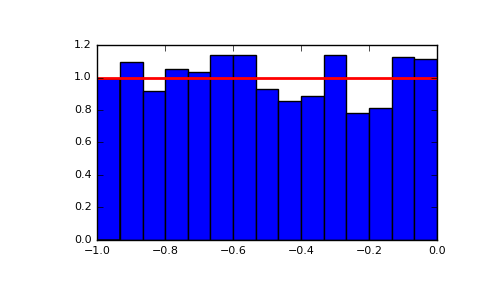
Display the histogram of the samples, along with the probability density function:
>>> import matplotlib.pyplot as plt >>> count, bins, ignored = plt.hist(s, 15, normed=True) >>> plt.plot(bins, np.ones_like(bins), linewidth=2, color='r') >>> plt.show()(Source code, png, pdf)
-

© 2008–2016 NumPy Developers
Licensed under the NumPy License.
https://docs.scipy.org/doc/numpy-1.11.0/reference/generated/numpy.random.uniform.html